
Miami-Dade County Release Meaning
A Miami-Dade County release record identifies the custody episode that ended, the effective date and time, the authority for the change, and what happened next. A name that vanishes from the live jail roster does not answer those points. The person may have posted bond, entered pretrial release, served a county sentence, moved to monitored release, transferred to the Florida Department of Corrections, or entered federal or immigration custody. MDCR records the county transaction. The Miami-Dade Clerk records the court act. FDC, BOP, and ICE each record their own custody.
Leaving Turner Guilford Knight, Pre-Trial Detention, or Metro West for the community is different from leaving one of those facilities in transport to another custodian. A transfer ends the MDCR facility entry, but it does not end confinement. A released person also may remain under probation, parole, conditional release, or community control. Read the release type and destination, then check the next system when the record names one.
- Discharge
- The formal end of custody or supervision.
- Time served
- A sentence resolved with credit for time spent in custody.
- Detainer
- A request from another authority to hold or receive a person.
- Expunction
- Court-ordered relief that restricts public access to an eligible record.
Miami-Dade County Release Types
Miami-Dade County released inmates do not all follow one path. Bond and release on recognizance let a person leave county custody while the case continues. A court may order release, dismiss a charge, impose probation, or credit time served. A completed county sentence ends at MDCR, while a state-prison sentence normally leads to FDC intake. An ICE or federal hold may send the person to another agency. The release transaction and court docket should agree on the reason, though their posting times may differ.
| Release path | Meaning | Next record |
|---|---|---|
| Bond or recognizance | County custody ends while the case remains open. | MDCR and Clerk docket |
| Pretrial release | Community conditions replace physical jail custody. | Pretrial Services and court order |
| Time served | The county custodial term is complete. | Release transaction and judgment |
| Probation | Jail ends while supervision begins or continues. | FDC Supervised Population |
| FDC, BOP, or ICE transfer | Another agency takes custody. | Receiving agency record |
Miami-Dade County Release Record Fields
A precise request ties the release to one booking episode. Names can be shared, changed, or entered with aliases. A jail number, booking date, date of birth, and court case number reduce that risk. Ask MDCR for the booking record and release transaction, not merely an inmate search result. Request the date and time, release disposition or authority, and any nonexempt destination or hold. The court record supplies the judicial act behind bond, dismissal, probation, or sentence.
| Field | What it establishes |
|---|---|
| Name and identifiers | The person linked to the episode |
| Jail or booking number | The specific MDCR admission |
| Booking date and charges | The start and legal context |
| Release date and time | When MDCR custody changed |
| Release type or authority | Bond, order, time served, transfer, or other disposition |
| Destination or hold | Whether another custodian followed, when nonexempt |
The online 72-hour entry is quick evidence, not a guaranteed permanent archive. Its disappearance does not mean the agency record was destroyed. Florida retention turns on record schedules and the custodian's holdings. For durable proof, request the MDCR transaction and the pertinent Clerk document.
Request Miami-Dade Release Records
The MDCR corrections records portal accepts online requests and status tracking. State the full name, date of birth, jail number when known, booking date, and exact records sought. Ask for the booking and release record, effective date and time, disposition or authority, custody history, and transfer destination or hold if nonexempt. Ask for the booking photograph separately when needed.
- Identify the booking episode with the subject's details and approximate booking date.
- Describe existing records and fields instead of asking staff to create an explanation.
- Submit through the portal or contact Central Records for access and cost details.
- Review redactions and request the statute supporting a withheld field.
- Match the response to the Clerk case and follow any named transfer.
2525 NW 62nd Street, Suite 4200
Miami, FL 33147
786-263-5892
Fax: 786-263-5002
Published charges are 15 cents for a one-sided standard copy, 20 cents for a two-sided copy, and $1 for a certified or color page. A CD is $1, plus delivery. Work exceeding 20 minutes can result in a labor charge. MDCR publishes no blanket turnaround promise, so request an estimate.
The official request page shows the county path.
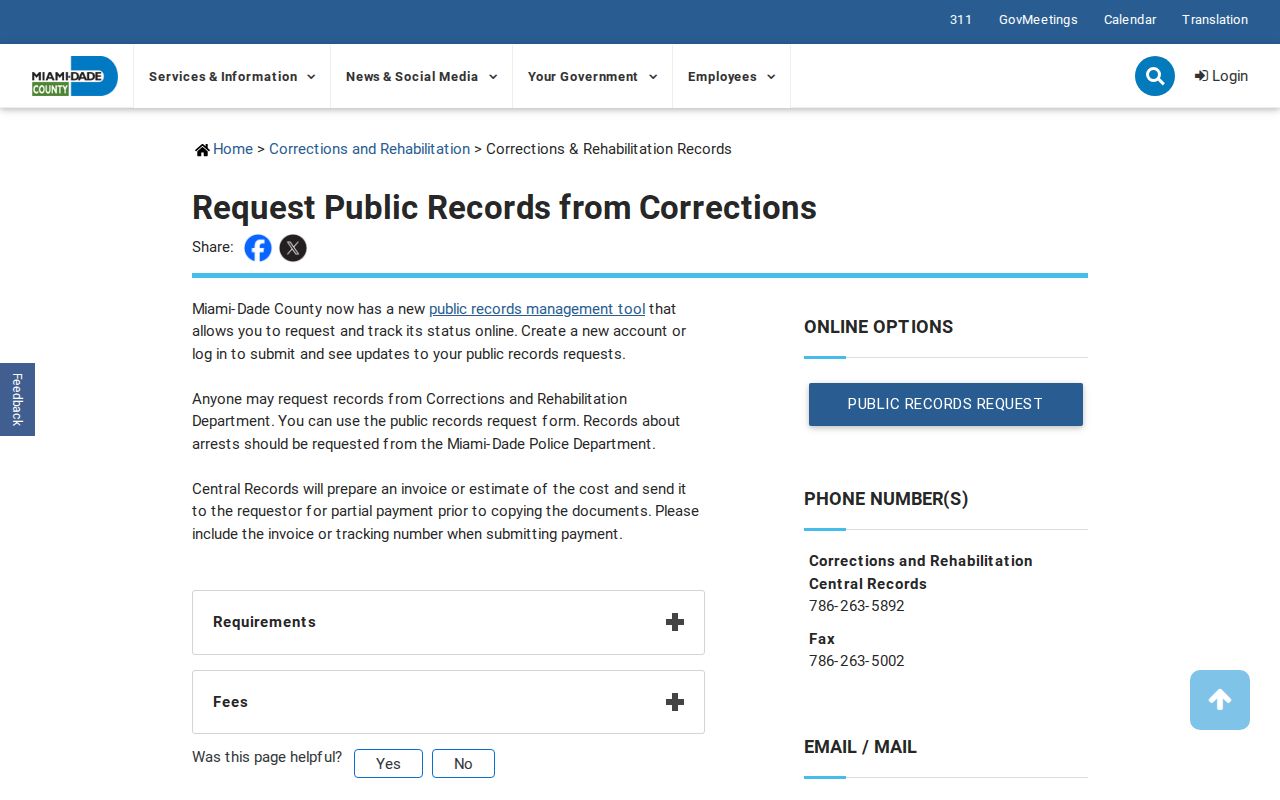
The instructions point to the form used when a web entry is gone or incomplete.
Florida Law on Release Records
Florida Constitution article I, section 24 and Florida Statutes section 119.07 establish access to nonexempt records. A custodian must permit inspection and copying at reasonable times, respond in good faith, make reasonable efforts to locate records, and cite a legal basis for withheld material.
Sealing and expunction are not automatic after dismissal. FDLE first reviews eligibility. A certificate does not close the record. The person must petition the court, obtain an order, and ensure FDLE receives the certified order. Public access may then change, subject to statutory exceptions.
Miami-Dade Bond Release Paths
Miami-Dade uses several terms for leaving custody before a case ends. Release on recognizance and the jail term Promised To Appear do not require payment of the full bond amount. Police may use a street citation in eligible circumstances. County Pretrial Services is a no-charge supervision route ordered in place of continued detention. Cash bond requires the full amount through the facility's TouchPay route, while a surety bond uses a licensed bond agent.
These are releases from a cell, not final outcomes. A county report recorded 5,800 defendants released into Pretrial Services during 2024, showing how physical release and case completion remain separate. The MDCR record confirms when processing ended. The Clerk docket shows the order and later case events. Another charge or detainer can delay departure after one bond is satisfied.
Note: A posted bond or signed court order does not predict the hour when MDCR will finish release processing.
Property After Miami-Dade Release
County booking property follows a local schedule separate from release-record retention. MDCR says property remains in the TGK Property Room for up to 30 days. After that point it moves offsite, and pickup must be arranged through 786-263-5355. Property returned from offsite but not collected within 72 hours goes back to storage. Unclaimed property is scheduled for destruction after the county's published post-release period under Implementing Order 7-20.
State-prison identification follows another rule. Under section 944.605, eligible Florida-born state prisoners receive a birth certificate and state identification before sentence-expiration release, subject to exceptions. That FDC duty does not control MDCR property pickup. The two systems should not be merged.
Where Miami-Dade Releases Exit
MDCR centralizes completed county releases at Turner Guilford Knight Correctional Center, even when the person was housed at Pre-Trial Detention or Metro West. The county release page states that releases occur from 6 a.m. through 9 p.m. regardless of whether transportation is waiting. Pickups use the front of TGK and follow the Inmate Release Area signs.
Bond or court clearance does not mean the person will appear at once. MDCR warns that processing may take several hours. Staff must resolve the booking episode, holds, property, and paperwork. The public window is a range, not an appointment. Call Release at 786-263-5360 with the jail number if the transaction is unclear. A transfer to FDC, BOP, ICE, or another jail does not use the community pickup path.
Find Miami-Dade County Released Inmates
The first search depends on the last custodian. Use the MDCR released-within-72-hours option for a recent county release. Use FDC Inmate Release Information for a state-prison term. Use BOP for federal custody and ICE ODLS for immigration detention. The court docket supplies the legal reason but may not show the hour when physical processing ended.
- Search the official MDCR application and choose its rolling 72-hour released listing.
- Check Florida VINE for the named person and reporting agency, then treat an alert as a lead.
- Call MDCR Inmate Information at 786-263-7000 or Release at 786-263-5360 for ambiguity.
- Review the Clerk case for bond, orders, disposition, judgment, and sentence.
- Request the archived booking and release transaction when the event is older.
- Follow a transfer into FDC, BOP, ICE, another county, or the named facility.
The MDCR inmate search contains the documented recent-release option.
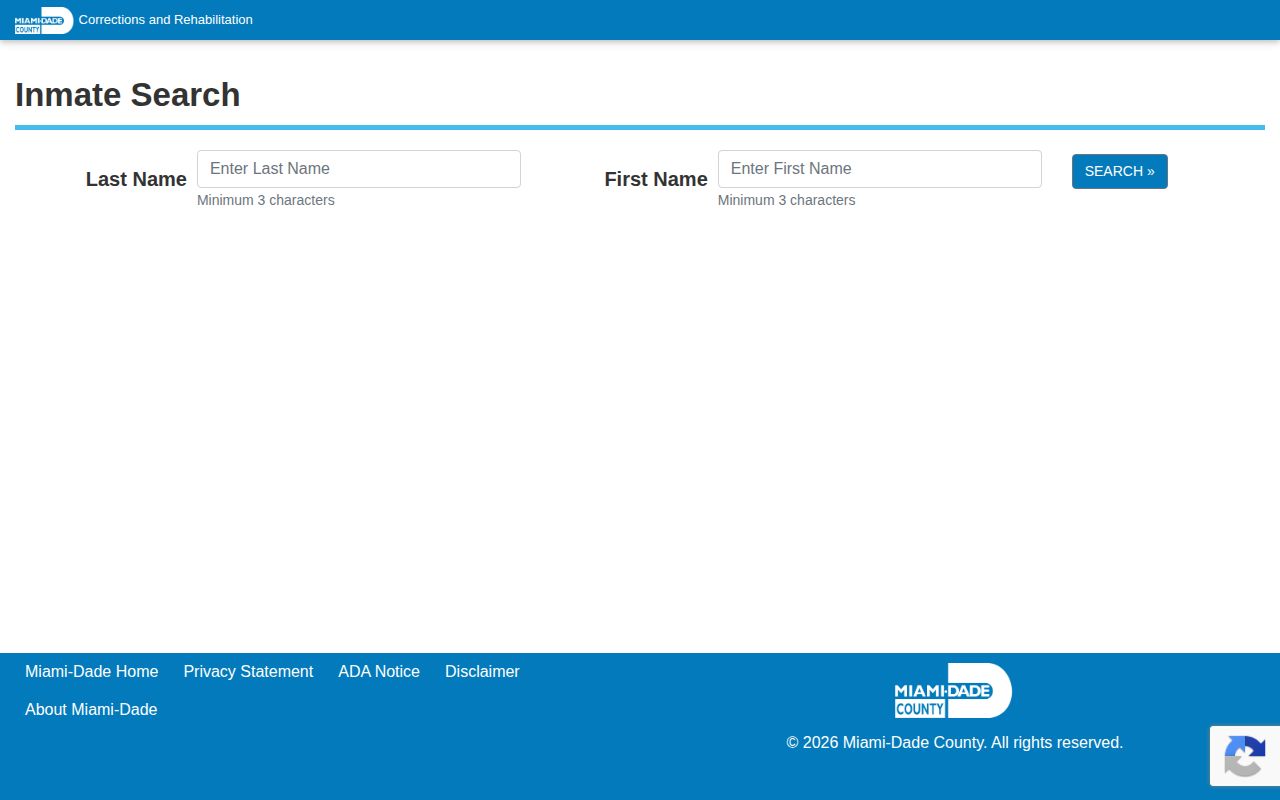
The application is a short recent-release view, not a permanent historical database.
FDC Search for Miami-Dade Releases
The FDC Corrections Offender Network separates active prison, inmate release, and supervised population searches. A person held only in a Miami-Dade jail does not gain an FDC record merely because the charge arose here. FDC applies after state corrections receives the person.
| Search or field | Use | Limit |
|---|---|---|
| DC number | Best identifier across FDC records | Not an MDCR jail number |
| Name and identifiers | Find and compare a match | Confirm aliases and photo |
| Inmate Population | Current prison and future date | Not a county release |
| Release Information | Release Date and Date Out-Custody | Supervision may continue |
| Supervised Population | Probation, parole, and office | Separate from prison custody |
For a former state prisoner, match the DC number and read Release Date with Date Out-Custody. Then run Supervised Population. On an active record, a future Current Release Date is a projection that may change through lawful credit, sentence action, discipline, detainers, or recalculation.
The public FDC released record demonstrates the fields.
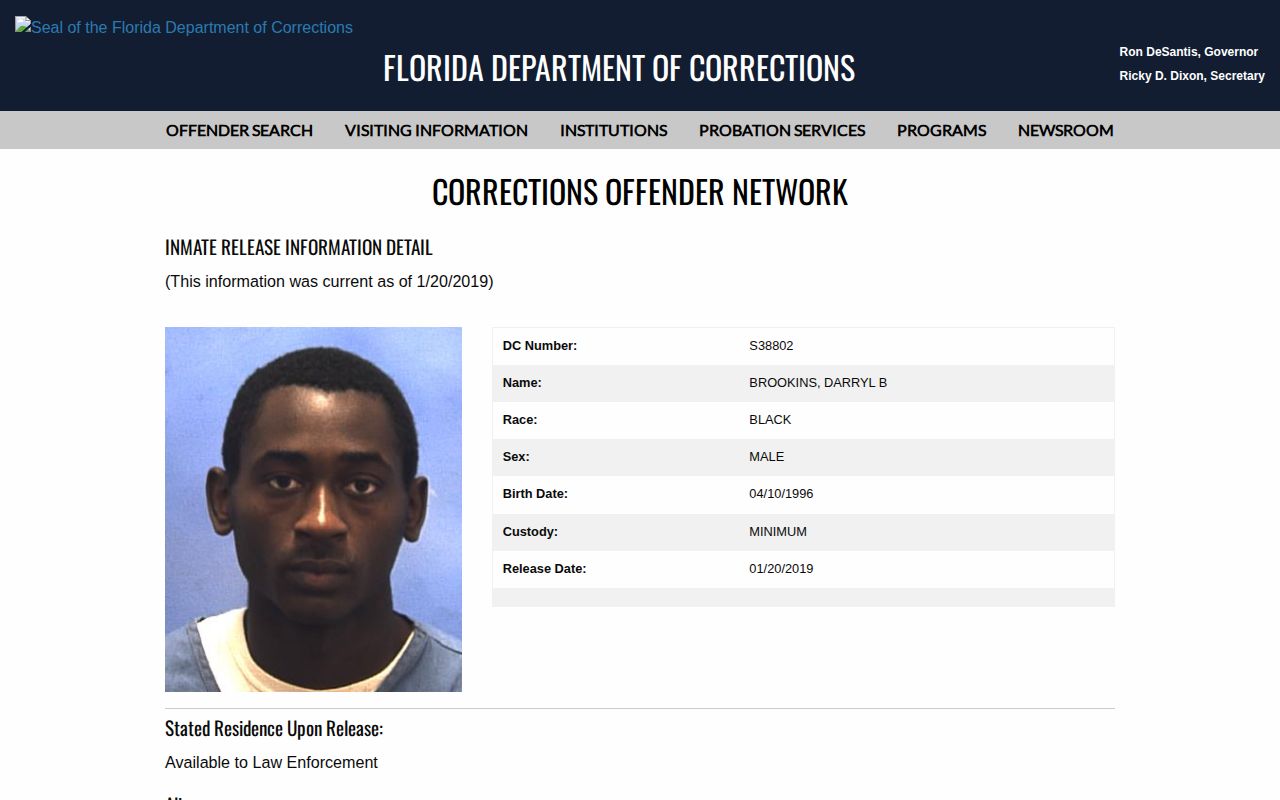
The record separates physical release from later supervision.
Miami-Dade County Recent Releases
Miami-Dade publishes a documented 72-hour release option inside its official name-search application. The county does not publish a distinct 24-hour feed. A last-day search may review the 72-hour results and use a displayed release time only if the live interface supplies it. That manual subset is not an MDCR-issued 24-hour list. The county provides no minute-by-minute update promise.
A current result means MDCR still associates the person with custody or monitoring. The closed NDCCC code is a local exception: it means electronic house arrest, not physical confinement. A removed record may reflect release or transfer. After the rolling window, call Release or Inmate Records, request the transaction, and use VINE, Clerk, FDC, ICE, or BOP as needed.
Miami-Dade Release Totals
The MDCR daily jail report supplies an official view of system flow. It reports bookings, people in custody, releases, facility census, 180-day population and length-of-stay measures, and immigration hold trends. The July 7, 2026 snapshot showed 158 booked and 161 released, with 4,963 in custody and a 180-day average daily population of 4,689.
These totals are not proof about a named person. They cannot identify the release reason or another agency's hold. Use the individual release entry or agency record for that purpose.
Miami-Dade Supervision After Release
Florida divides parole decisions from field supervision. The Florida Commission on Offender Review handles parole matters for the limited eligible group. FDC Community Corrections supervises probation, parole, conditional release, and other post-prison statuses. Search Supervised Population by name or the six-character DC number, confirm identifiers, and read the begin date, status, supervision type, office, and scheduled end date.
Active Suspense means the person is temporarily unavailable for direct supervision, often because of jail or another facility, while staff monitor the case. It does not mean unrestricted release. An absconder result concerns unavailable whereabouts and an issued violation warrant. Route questions to the listed authority. More detail appears on the Miami-Dade County Parole / Probation page.
Miami-Dade Release Reentry Services
MDCR's Reentry Program Services Bureau provides counseling, action plans, case management, and referrals through release. FDC also maintains a resource directory filterable by county, circuit, city, and ZIP. These services address transition needs. They do not prove that a person was released or show the legal terms of supervision.
Records and services answer different questions. Use MDCR, FDC, a court, BOP, or ICE to verify custody. Use the reentry programs for support once the custody path is known. A referral is not a release certificate, and an FDC resource listing is not proof of probation or parole.
Miami-Dade Release Alerts and Locators
Florida VINE covers MDCR county jails, FDC, and juvenile justice. A named search shows reporting agency and custody status. Phone, text, or email registration can provide notice of release, transfer, escape, death, or out-to-court. A VINE event is a relay, not a certified discharge record, so confirm whether it means community release or transfer.
BOP covers post-1982 federal records. A past date with Released or no institution means BOP custody ended, though supervision or another custodian may follow. ICE ODLS searches by A-number and country of birth or exact name and country. It retains recent released-from-ICE entries for 60 days. ICE paperwork and immigration-court status distinguish conditional release, removal, and transfer.
Miami-Dade Release Court Trail
The MDCR release listing expires after its rolling window, but the Miami-Dade criminal case search offers a longer legal trail. Circuit Criminal handles felonies, while County Criminal handles misdemeanors. Review bond events, dismissal entries, orders, disposition, judgment, sentence, time-served credit, and probation or community-control terms. The Clerk cautions that its web display is not the official record.
A certified disposition or judgment can establish the outcome after the release card is gone. It may not show the exact moment MDCR completed processing. Request the agency transaction for that. Published Clerk fees include $1 per page, $2 per document for certification, and a separate $7 certified disposition letter.
The official case portal shows where the search begins.
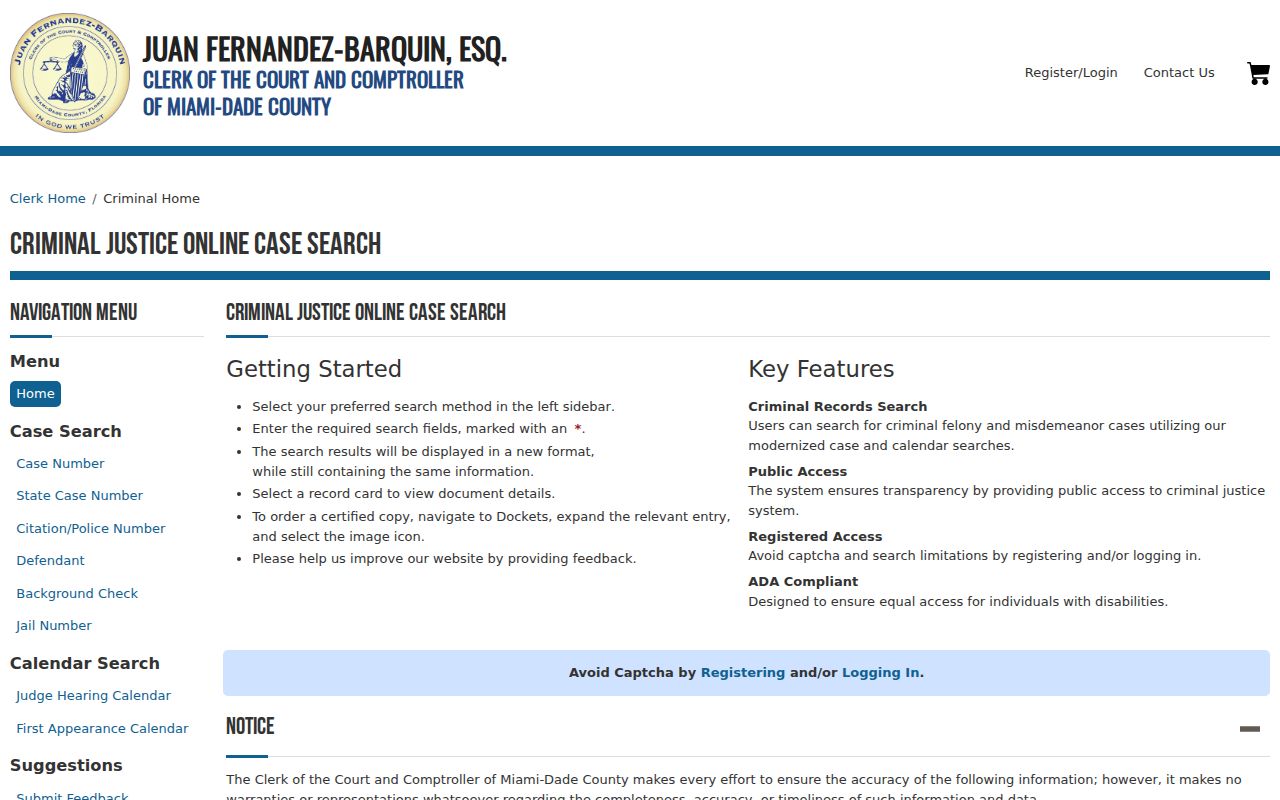
The docket supplies the legal reason, while MDCR supplies the custody completion time.
ICE Holds After Miami-Dade Release
The MDCR daily report tracks immigration holds and detainers. A county roster disappearance therefore cannot always be read as community release. If the transaction says ICE assumed custody, search ODLS by nine-digit A-number and country of birth when possible. Add leading zeroes to a shorter number. The other route uses exact first and last name, country of birth, and optional date of birth.
ODLS keeps certain released-from-ICE entries searchable for 60 days. A result still needs context. ICE release may mean conditional release, removal, or transfer. The Detention Reporting and Information Line, 1-888-351-4024, handles basic questions Monday through Friday from 8 a.m. to 8 p.m. Eastern.
Miami-Dade Release Lookup Comparison
Each tool answers a limited custody question. Start with the agency that last held the person and move only when a transaction, judgment, or detainer points elsewhere.
| System | Still in custody | Released or transferred |
|---|---|---|
| MDCR | Live location or monitoring code | 72-hour entry or requested transaction |
| FDC | Inmate Population status | Release Information plus supervision |
| VINE | Reporting-agency status | Status alert needing confirmation |
| BOP | Federal institution | Past date and Released status |
| ICE | ODLS detention result | Recent released record with context |
| Clerk | Court and bond context | Order, judgment, or disposition |
Miami-Dade Release Facilities
County custody uses Turner Guilford Knight Correctional Center, Pre-Trial Detention, Metro West, and the Boot Camp Program. Completed community releases route through TGK. Dade, Homestead, Everglades, South Florida Reception Center, and its South Unit are FDC institutions. Federal Detention Center Miami, FCI Miami, and RRM Miami use BOP records. Krome uses ICE ODLS.
- Turner Guilford Knight Correctional Center
- Pre-Trial Detention Center
- Metro West Detention Center
- Boot Camp Program
- Dade Correctional Institution
- Homestead Correctional Institution
- Everglades Correctional Institution
- South Florida Reception Center
- South Florida Reception Center South Unit
- Federal Detention Center Miami
- Federal Correctional Institution Miami
- Residential Reentry Management Miami
- Krome North Service Processing Center
The navigation lists every facility. A location change inside FDC or BOP is not release. RRM Miami is an administrative office, not proof of residence. Krome departure may mean transfer, removal, or community release. Match the record to the operating agency.