
Boot Camp Release Outcomes
Miami-Dade Corrections and Rehabilitation operates the Boot Camp Program within the county correctional system. Its participants have been adjudicated as adults. That status makes the court case central to interpreting a departure. Program completion may lead to a court-authorized transition, community supervision, another MDCR placement, or another custody result reflected in the individual record.
The facility name alone cannot prove discharge. MDCR records the county custody event, while the Clerk docket records the judicial authority. If another custodian receives the person, the receiving system supplies the next status. Calling every program departure a release would erase those differences.
| Question | Source |
|---|---|
| Did MDCR custody end? | MDCR release or custody-history transaction |
| What did the court authorize? | Miami-Dade Clerk docket and order |
| Did supervision follow? | Applicable county or FDC supervision record |
| Did another agency receive the person? | Receiving agency locator or record |
Confirm Boot Camp Release
The program does not have a separate public release roster. Start with the official MDCR name search and its released-within-72-hours option when the event is recent. Match identifiers and note any displayed booking or release fields. Then call the Release Unit or Inmate Information if the result is delayed or uncertain.
A useful sequence is:
- Reach the recent-release option through the official MDCR search FAQ.
- Match the full name, jail number, and booking episode where available.
- Ask the Release Unit at 786-263-5360 whether county custody ended and what disposition is recorded.
- Search the Clerk criminal docket for the program-related order or later court action.
- Check Florida VINE for the reporting agency’s custody-status event.
- Request the MDCR custody history when the public web window has passed.
If the record indicates an FDC, federal, county, or ICE transfer, continue in that system. The Miami-Dade released-inmate record path separates each receiving locator and explains why a transfer is not community release.
Boot Camp Court Authority
The Miami-Dade criminal case supplies the legal frame for participation and any later transition. Search by case number when possible. Review docket entries, orders, sentence material, and disposition rather than treating the current MDCR location as the full account. The Clerk’s public screen is a finding aid, not the official record. A certified order is stronger when exact judicial authority matters.
MDCR’s transaction adds the operational fact: when county custody or a program placement changed and where the record says the person went. A court order may authorize release, but processing can continue after the order is entered. Conversely, a placement change may occur without a final discharge. The two records should agree before the event is characterized.
- Program completion
- Completion of the correctional program requirements shown in the relevant record.
- Community supervision
- Release from physical custody while stated legal oversight continues.
- Discharge
- The end of the custody or supervision term recorded by the responsible authority.
- Transfer
- A move to another placement or custodian.
Note: A court result and an MDCR custody transaction prove related but distinct parts of a Boot Camp transition.
Boot Camp Releases Exit TGK
Unless an individual record shows otherwise, MDCR’s published county rule routes completed physical releases through Turner Guilford Knight Correctional Center. The front TGK exit is marked by “Inmate Release Area” signs. Releases are conducted from 6 a.m. through 9 p.m. without regard to whether personal transportation is available.
The published window does not promise one person’s exit time. MDCR warns that processing may take several hours after legal conditions are satisfied. Staff must verify authority, check holds, complete the transaction, and handle the physical release. Pickup planning should therefore rely on current confirmation rather than an estimate based only on a docket entry.
The official MDCR release process documents this centralized route. The image captures the agency’s process page.
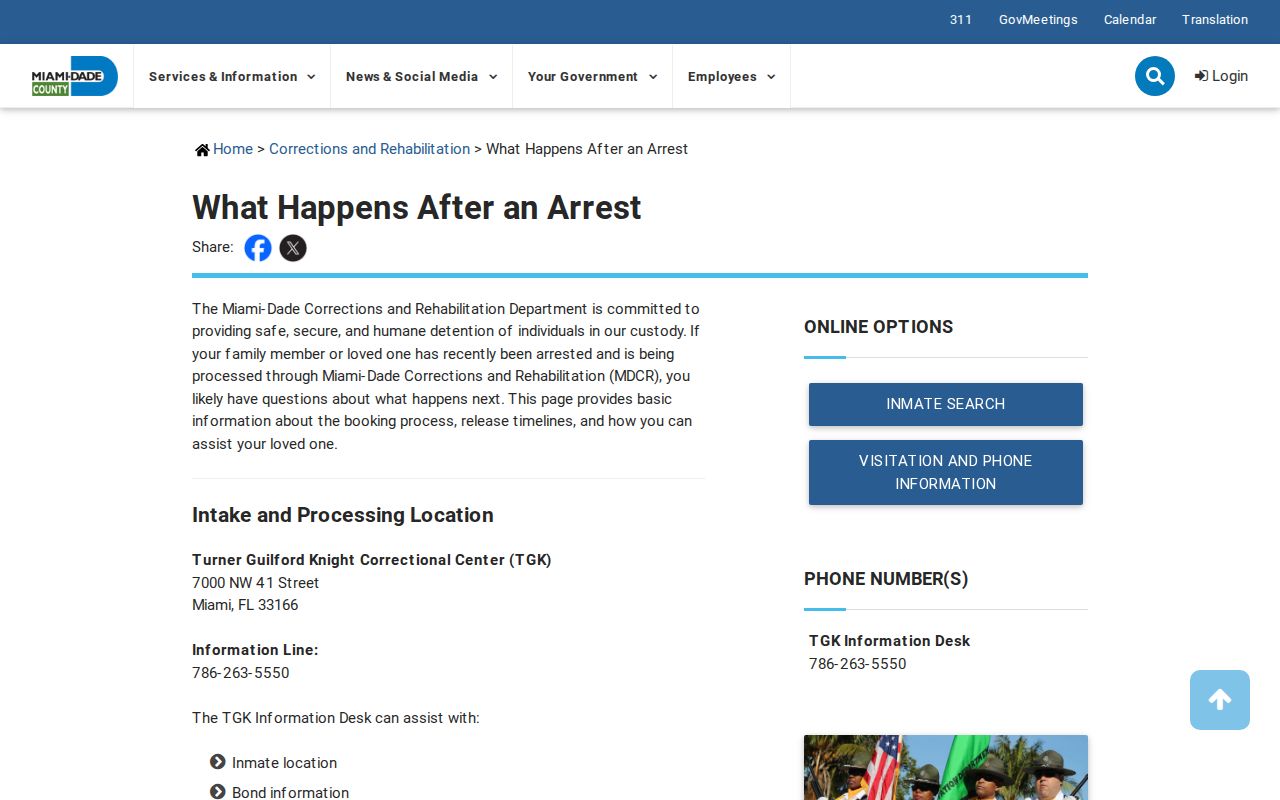
The source clarifies the exit location, while the participant’s records establish whether a release was approved and completed.
Boot Camp Records Request
For an archived or detailed record, file with MDCR Central Records. Supply the full name, date of birth, jail number if known, booking or program dates, and a precise description. Ask for the custody-history entry, release date and time, release type or authority, transfer destination or hold if nonexempt, and records showing the relevant program transition. A request for existing records is more precise than asking staff to compose an explanation.
MDCR Central Records
2525 NW 62nd Street, Suite 4200
Miami, FL 33147
Phone: 786-263-5892
Fax: 786-263-5002
The MDCR request portal accepts and tracks online requests. Published fees include 15 cents for one-sided standard copies, 20 cents double-sided, and $1 per certified or color page. Delivery can be added. More than 20 minutes of processing may lead to a labor charge and an advance partial payment. Request an estimate because no fixed turnaround applies to every record.
Florida public access is broad but subject to exemptions. Protected information may be redacted, while nonexempt portions should still be produced. The short recent-release web window is not the retention period for the underlying program and custody records.
Boot Camp Program Contact
The program is listed at 6950 NW 41st Street, Miami, Florida 33166. Its telephone is 786-263-5810. Use that line for program-specific routing. Use the Release Unit for a current county release transaction and Central Records for copies.
Miami-Dade Boot Camp Program
6950 NW 41st Street
Miami, FL 33166
Program: 786-263-5810
Release Unit: 786-263-5360
The official Boot Camp Program page is the subject source for the captured image below.
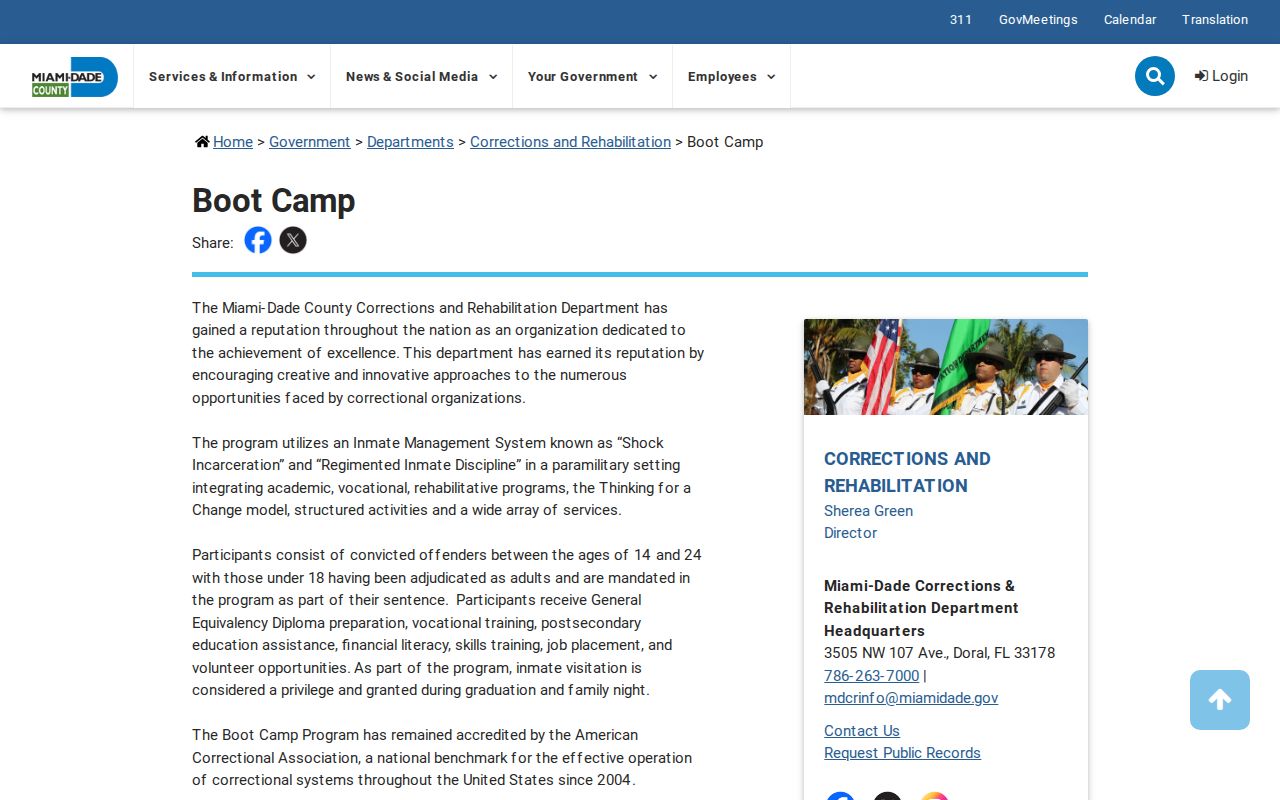
The county page establishes the program context. A named participant’s custody and court records still control the release finding.
Note: The Boot Camp telephone answers program questions; MDCR Central Records is the custodian for a copy of the county transaction.
Boot Camp ICE Transfers
Miami-Dade reports immigration holds and detainers in its jail system data. A detainer is a request from another authority concerning custody when the local basis ends. If an individual Boot Camp or MDCR transaction identifies ICE, the person may have left county custody while entering immigration custody.
Search the ICE Online Detainee Locator System by nine-digit A-number and country of birth, or by exact name and country of birth. ICE says ODLS includes people released from its custody within the prior 60 days. Use ICE paperwork or immigration-court status to distinguish conditional release, transfer, and removal.
MDCR’s daily system totals can show that immigration holds exist, but aggregate counts do not prove a named participant’s destination. The individual transaction must make that connection. If it does, preserve the MDCR number and obtain the A-number when available so the two agency records can be matched with less risk of name confusion.
A local court order can end the county basis for custody while leaving the immigration question unresolved. The Clerk record therefore does not replace ODLS, ERO paperwork, or immigration-court status. Each source owns one part of the sequence.
Boot Camp Release Record Fields
A complete request should capture which county episode changed, when the change took effect, who authorized it, and what followed. The most useful fields are the jail number, booking or program episode, effective date and time, release disposition or type, authorizing court or agency, and destination. If community supervision followed, ask for the linked authority rather than assuming its terms from the custody record.
The 72-hour public display can help identify the right episode, but it is not a complete program archive. Save the booking and case numbers at once. Once the short display expires, those identifiers help Central Records and the Clerk locate the same event. A certified court order and an agency custody transaction offer stronger proof than a screenshot alone.
Sealed, expunged, juvenile, protected-person, or corrections-security material may be restricted under Florida law. A redaction does not erase the rest of a responsive record. Ask the custodian for the nonexempt portion and the statutory basis for withheld material.
Note: Program records, court orders, and custody transactions overlap, but each custodian can produce only the records it maintains.
Boot Camp Record Limits
A recent-release result is a fast status aid, not a full program history. It may not explain the court authority, supervision terms, or later transfer. Preserve the jail and case numbers, then obtain the source documents that answer those points.
Public access is also subject to lawful redaction. A missing or restricted field should not be filled with an assumption. Ask the custodian to provide the nonexempt remainder and identify the legal basis for any withheld part.