
SFRC Release or Transfer
South Florida Reception Center is operated by the Florida Department of Corrections, or FDC. It is not an MDCR county jail. As a reception and processing prison, SFRC is a point where people are classified and moved within the statewide system. The six-character DC number links those moves to one corrections record.
A departure from SFRC most often needs a transfer check first. If a later FDC institution appears, prison custody continued. A true release is supported by Release Date and Date Out-Custody. Probation, parole, conditional release, or another supervision type may then appear in the separate Supervised Population result.
| Event | Meaning |
|---|---|
| New FDC location | State custody continues at another institution |
| Release Date and Date Out-Custody | FDC physical custody ended on the recorded date |
| Active supervised record | The person is outside prison but under FDC supervision |
| No public match | Identifiers or agency records need further checking |
Confirm an SFRC Release
Begin at the FDC search menu and choose Inmate Release Information for a person who has left state prison. Search by DC number when known. A name search can use full or partial names, but the matching detail must be checked through aliases, demographic fields, photograph, offense history, and the DC number.
Follow this state-record sequence:
- Open the FDC Corrections Offender Network.
- Select Inmate Release Information for historical or scheduled release records.
- Search by DC number, or narrow a name match with the available identifiers.
- Read Release Date together with incarceration history’s Date Out-Custody.
- Run the Supervised Population search to check post-prison supervision.
- Request FDC records if public fields conflict or a transaction needs formal confirmation.
The Miami-Dade Clerk judgment can establish the sentence imposed in a local case. It does not replace FDC’s custody history. Likewise, the MDCR 72-hour county release listing does not cover a state-prison departure. The Miami-Dade release record overview compares those county and state paths.
SFRC Release Record Fields
FDC’s public system separates active inmate population records, released-inmate records, and supervised-population records. This design prevents one screen from answering every question. On the released detail, Release Date and Date Out-Custody are the key historical fields. Location history helps show whether a person moved within FDC before release.
A future release date on an active record is an estimate based on controlling sentences and lawful credits. It is not an appointment for release at a fixed hour. Sentence changes, court credit, gain-time decisions, disciplinary loss, detainers, and recalculation can alter it. On a released record, the historical fields provide stronger evidence that the FDC custody episode ended.
- DC number
- FDC’s person identifier used across prison and supervision records.
- Date Out-Custody
- The history field recording departure from FDC physical custody.
- Gain-time
- Sentence credit calculated under Florida law and FDC rules.
- Community supervision
- Legal oversight outside prison, including probation or conditional release.
Note: Read the date, status, and location history together; no single field explains every custody transition.
SFRC Post-Release Supervision
After confirming an out-custody date, search FDC’s Supervised Population database. Public detail can include the supervision begin date, current status, supervision type, scheduled termination date, current location, offense and case history, and a circuit-office link. An active entry generally means the person is in the community but remains subject to state supervision.
Probation is court-ordered supervision. Parole applies to a limited Florida population and is decided by the Florida Commission on Offender Review. Conditional release and other categories have their own authority. None should be inferred from the prison release date alone. The supervision result names the actual type.
If the status is Active Suspense, FDC says the person is temporarily unavailable for direct supervision, often because the person is in a jail or another facility while the case is still monitored. That is not unrestricted release. A separate Absconder/Fugitive search covers a person whose location is unknown for supervision and for whom a violation warrant has issued.
SFRC Release Records Request
FDC public records can supply an SFRC reception history, later location entries, release date or type, transfer or discharge transaction, and release-date audit. Identify the DC number and ask for the full custody path. That wording helps separate routine reception transfer from a genuine release out of state custody.
FDC Public Records
James Best, Records Custodian
501 S. Calhoun Street
Tallahassee, FL 32399
Assistance: 850-717-9774
Bureau of Admission and Release: 850-488-9167
Use the FDC public-records portal for a trackable request. Florida chapters 119 and 945.10 govern access and corrections-related exemptions. Protected fields may be redacted. Ask for the nonexempt remainder and the statutory basis when information is withheld.
Florida’s general copy rule permits up to 15 cents for a one-sided page, five additional cents for a two-sided page, up to $1 for certification, and reasonable charges for extensive work. An agency may provide an estimate. Online display length does not set the legal retention period.
SFRC Records and Contact
South Florida Reception Center is at 14000 NW 41st Street, Doral, Florida 33178-3003. FDC lists it separately from the South Unit. Facility contact can help with a current institutional question, but the statewide record remains the correct source for a person’s transfer and release history.
South Florida Reception Center
14000 NW 41st Street
Doral, FL 33178-3003
Operator: Florida Department of Corrections
Release records: statewide FDC search and records office
The official SFRC facility page identifies the reception center used for this search path.
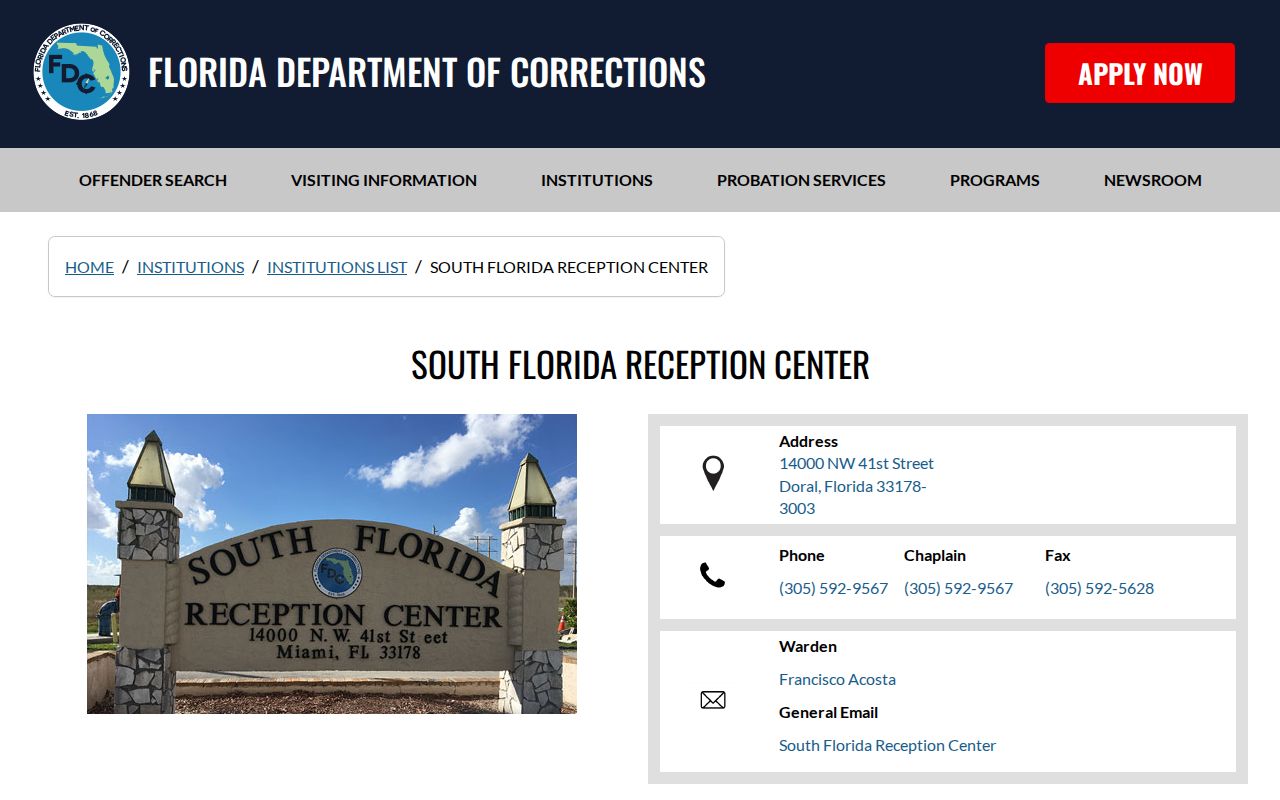
The image confirms the facility source; the person-level DC-number history decides whether the next event was transfer or release.
SFRC Release Date Rules
Florida Statute §944.275 governs the tentative state-prison release date. FDC starts with the sentence or combined sentences, applies lawful credit, and adjusts the tentative date as gain-time is granted, restored, or forfeited. For covered offenses committed on or after October 1, 1995, the statute prevents gain-time from producing release before 85 percent of the sentence has been served. Court-awarded physical-incarceration credit counts in that calculation.
The Miami-Dade judgment supplies sentence terms and jail credit under §921.161. FDC performs the state-prison calculation after receipt. A projected date may change and should not be treated as a guaranteed gate date. For a disputed calculation, request the audit and supporting custody history from FDC rather than applying a generic formula.
County-jail good time under §951.21 is a separate framework. It does not control an SFRC state-prison sentence. Reception in Miami-Dade County does not turn the state record into an MDCR record.
A future date can also be affected by a detainer or hold. Such an entry can change where the person goes after FDC custody ends. It should be verified through the release transaction rather than guessed from the projected date. FDC’s out-custody history confirms the prison departure, while the receiving agency’s record confirms the next status.
No generic rule turns an SFRC state-prison departure into a Miami-Dade county release. TGK’s exit process, MDCR’s recent-release list, and county good-time provisions belong to another system. They do not follow a person into FDC reception.
SFRC Transfer Record Reconciliation
Conflicting dates should be compared by source and function. The Clerk judgment establishes sentence terms and court-awarded credit. FDC’s active record shows the current calculation. Inmate Release Information records the completed state custody event. Supervised Population shows what legal oversight followed outside prison.
Start with the DC number and case number. Compare offense and sentence information, aliases, date fields, and location history. If the public screens still disagree, ask FDC for the incarceration and release history plus the calculation audit. Obtain the relevant certified court order when the dispute concerns the sentence itself.
Florida VINE may provide a prompt custody-status alert, but it is not a replacement for those records. A VINE event can flag a release or transfer. The FDC transaction supplies the lasting state-custody detail needed to tell them apart.
Note: The strongest SFRC finding pairs the location history with the release transaction and any later supervision record.
SFRC Detainers After Release
A hold or detainer can redirect a person after SFRC processing. FDC may show departure from state prison custody while another agency assumes custody. The event is an FDC release, but it is not proof of return to the community. Ask for the transfer or discharge transaction when the public fields do not name the next custodian.
If the record identifies immigration custody, search the ICE Online Detainee Locator System. ICE documents a 60-day window for people released from ICE custody. That locator must still be read with ERO or immigration-court material because conditional release, removal, and transfer have different meanings.
A local or federal receiving agency needs its own search. This is especially important at a reception center, where movement is common. A new location can be routine classification, a cross-system transfer, or a completed release. Only the linked records show which one occurred.