
Miami-Dade 24-Hour Release Source
The official Miami-Dade Corrections and Rehabilitation Department, or MDCR, search does not include an independently published 24-hour feed. The county documents one name-search application with an option listing people released during the prior 72 hours. That official three-day view is the starting point for a same-day check. If the live entry shows a usable release date and time, compare it with the current local time to isolate the last 24 hours. If it does not show enough time detail, do not label an entry as a same-day release based on guesswork.
The distinction matters because the live inmate side of the application reports custody, location, and charges, while the recent-release option reports a change in MDCR custody. A person missing from the current side is not automatically released to the community. The person may have moved to the Florida Department of Corrections, another jail, federal custody, or ICE. The official MDCR inmate-search FAQ confirms the 72-hour option but does not promise instant updates.
Check Miami-Dade Same-Day Releases
Use the official county application first, then move to a direct channel if the screen is unclear. The form requires at least three characters of both the first and last name. Miami-Dade does not provide a public switch that turns the rolling list into a separate 24-hour product, so the displayed record must support any same-day conclusion.
- Open the MDCR inmate search and choose the released-within-72-hours option.
- Enter at least three characters of the first and last name. Compare the result with known identifiers and the booking episode.
- Read the displayed release information. Use a timestamp only if the application actually provides one for that result.
- Call MDCR Release at 786-263-5360 when the change is new, the time is missing, or the destination is not clear.
- Ask whether MDCR custody ended, when it took effect, and whether the event was a community release, monitored release, or transfer.
For one named person, the broader release and records path is covered on the Miami-Dade County released-inmate search. Keep the jail number, booking number, or case number when available. Those identifiers make later calls and record requests more precise than a name alone.
The official MDCR search screen shows the form used for both current and recent-release paths. The county search is the source for this captured view.
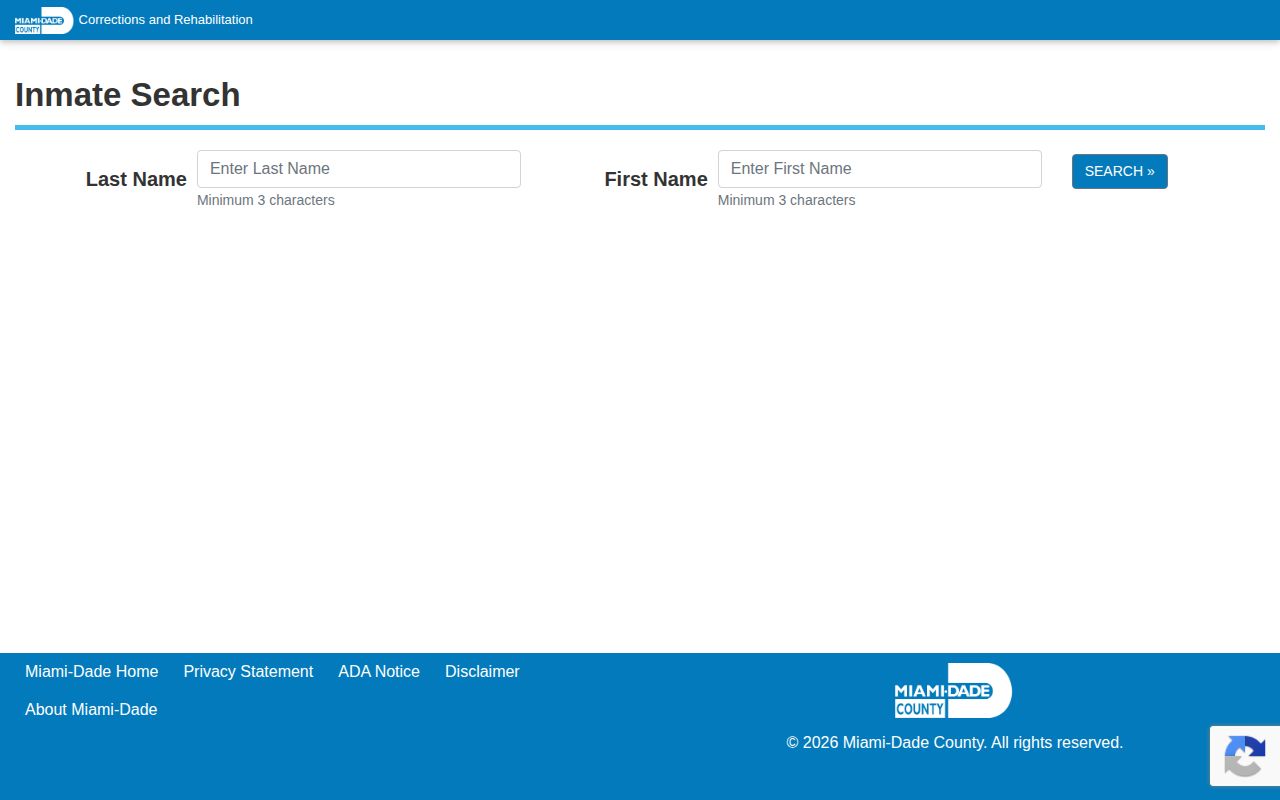
The screen is an entry point, not a certified release record. Use the release unit or a records response when the exact event matters.
Miami-Dade Release Fields to Read
MDCR documents the fields on its current-custody results, but it does not promise that every one appears on a released card. Read only what the live result displays. A county agency record can contain a fuller booking and release transaction, including the release time, authority, and destination, when the public card is incomplete.
| Field or detail | How it helps |
|---|---|
| Name and identifiers | Help distinguish people with similar names and connect the entry to one booking episode. |
| Jail or booking number | Gives MDCR a precise key for a call or records request. |
| Release date and time, if shown | Supports a manual last-24-hours comparison. Do not infer a time the card omits. |
| Location or facility | Shows the MDCR placement context, but not necessarily the physical release point. |
| Charges and bond data | Provide booking context but do not by themselves prove why custody ended. |
| Release type or destination, if shown | Helps separate return to the community from monitoring or transfer. |
A useful Miami-Dade release request should ask for the effective date and time, release reason or type, authorizing court or agency, and destination. Bond posted, release on recognizance, time served, probation, transfer, and an ICE detainer are not the same outcome. The Clerk docket can supply the court action behind a bond, dismissal, sentence, or release order.
Note: The county has not published a guaranteed minute-by-minute refresh schedule for its recent Miami-Dade release results.
Miami-Dade 24-Hour Release Fallbacks
Because no official Miami-Dade 24-hour feed exists, a failed search should lead to corroboration, not a conclusion. Start with Florida VINE for a named person and reporting-agency status. Then call MDCR Inmate Information at 786-263-7000 or Release at 786-263-5360. For a durable account, request the booking and release transaction from MDCR Central Records and state the jail number, booking date, and exact fields needed.
The next system depends on the destination. Search FDC Inmate Release Information when a Miami-Dade sentence led to state prison. Use the BOP locator for federal custody and the ICE Online Detainee Locator System when the transaction names immigration custody. The Miami-Dade Clerk's criminal case search can explain a bond action, court order, disposition, or sentence. None of those systems should be substituted for the agency that actually held the person.
- Community release
- MDCR custody ends and the person returns to the community, with or without court-ordered monitoring.
- Transfer
- MDCR custody ends because another jail, FDC, BOP, or ICE receives the person.
- Discharge
- A custody or supervision term ends under the controlling record. It is more specific than disappearing from a roster.
- Detainer
- A request or hold tied to another authority that may affect where the person goes next.
Miami-Dade Release Versus Custody
A current MDCR result generally means the person remains associated with county custody or monitoring. A recent-release result means MDCR reported an end to that custody episode, but the next status may still require another search. The closed NDCCC location code is a Miami-Dade-specific exception. MDCR says it denotes house arrest with an ankle monitor, not a person housed in a jail and not an unrestricted discharge.
| Observed status | What to do next |
|---|---|
| Current MDCR jail location | Treat the person as still tied to county custody and use MDCR for status. |
| Recent MDCR release entry | Confirm the release type and effective time through Release or the transaction record. |
| NDCCC code | Recognize electronically monitored house arrest, not physical jail placement. |
| Transfer to FDC | Follow the person in the statewide FDC system after intake is processed. |
| Federal or ICE transfer | Use the receiving federal locator and do not call the county exit a community release. |
The same rule applies to roster absence. A removed live entry can reflect release, transfer, a restricted record, or a data change. The 72-hour option is better evidence of a recent MDCR release, while the agency transaction and court record explain what happened.
Where Miami-Dade Releases Happen
Miami-Dade centralizes completed county releases at Turner Guilford Knight Correctional Center, known as TGK. That applies even when the person was held at Metro West or the Pre-Trial Detention Center. The facility assignment shown during custody and the place where a person exits are therefore separate facts.
MDCR states that releases occur from 6 a.m. to 9 p.m. regardless of whether personal transportation is ready. The county's newer process instructions direct pickups to signs for the front Inmate Release Area. Processing may still take several hours after bond or court requirements have been met. A posted bond time is not a promised exit time, and the web entry may trail the physical process.
The official after-arrest and release process gives the TGK release-area route. This local direction explains why a family pickup may be at TGK even when the earlier roster named another MDCR facility.
Miami-Dade Same-Day Release Types
Local terms can explain why a person left a cell while the criminal case remains open. Miami-Dade materials describe court release on recognizance, jail Promised To Appear, a police street citation, no-charge Pretrial Services, cash bond, and surety bond. Cash bond uses the full amount through the facility's TouchPay route. A surety bond uses a licensed bond agent. Each route changes custody, but none alone states that the case ended.
Pretrial release is especially important in a same-day list. A person may return to the community under conditions while awaiting later hearings. Probation or community control can also follow a sentence. A transfer to state or federal custody, by contrast, ends MDCR custody without returning the person to the community. Ask for the release authority and destination instead of reducing every entry to “freed.”
Note: Court action, bond processing, MDCR release completion, and the public search update can occur at different times.
Miami-Dade Release Search Quirks
Two local details prevent a simple roster-present or roster-absent reading. First, Miami-Dade documents one search with a 72-hour release option, not separate official 24-hour and 72-hour feeds. A same-day view is only a manual reading of the official wider list when its displayed times allow that. Second, NDCCC is a closed facility code that represents electronic monitoring at home.
No official MDCR or Miami-Dade Sheriff's mobile application was found with a distinct release or booking-photo stream. The county offers a responsive web search and VINE registration instead. A community reporting app should not be treated as an inmate locator. For a longer view that can catch an entry missed during a same-day check, use the Miami-Dade releases from the last 72 hours.