
Miami-Dade Parole vs Probation
Parole and probation both place rules on a person living in the community, but they begin differently. A court orders probation, often instead of jail or after a jail term. The Florida Commission on Offender Review, or FCOR, authorizes parole for a limited eligible group after state prison. Ordinary Florida parole was effectively abolished for offenses committed on or after October 1, 1983, though older and special statutory groups remain. Eligibility comes from the sentence and case record, not a date slogan.
FDC Community Corrections officers supervise probation, parole, conditional release, and other post-prison programs. Thus, FCOR may make a parole decision while FDC maintains the active supervision record. A prison release date proves only that confinement ended.
| Point | Parole | Probation |
|---|---|---|
| Who orders it | FCOR in an eligible case | The sentencing court |
| Prior custody | State prison | May replace or follow jail |
| Field agency | FDC Community Corrections | FDC Community Corrections |
| Best proof | FCOR action plus FDC status | Court order plus FDC status |
| End point | Formal discharge or action | Formal termination or discharge |
Verify Miami-Dade Post-Release Supervision
The official FDC Supervised Population search is the practical starting point. It accepts a name or six-character DC number. Compare the photograph and identifiers before opening a record. Then read supervision begin date, current location, current status, supervision type, scheduled termination date, offense history, and linked circuit office as a set.
- Enter the name or DC number and include aliases when appropriate.
- Match identifiers and the photograph, not the name alone.
- Read status, supervision type, start date, and expected termination date.
- Open the location link for the assigned circuit office.
- Compare probation with the court order, or parole with the FCOR action.
A county-jail release may lead to probation without any state-prison record. Use the Miami-Dade release record path for that custody event, then check FDC for community supervision.
The official supervision form shows the person-search channel used for Miami-Dade cases.
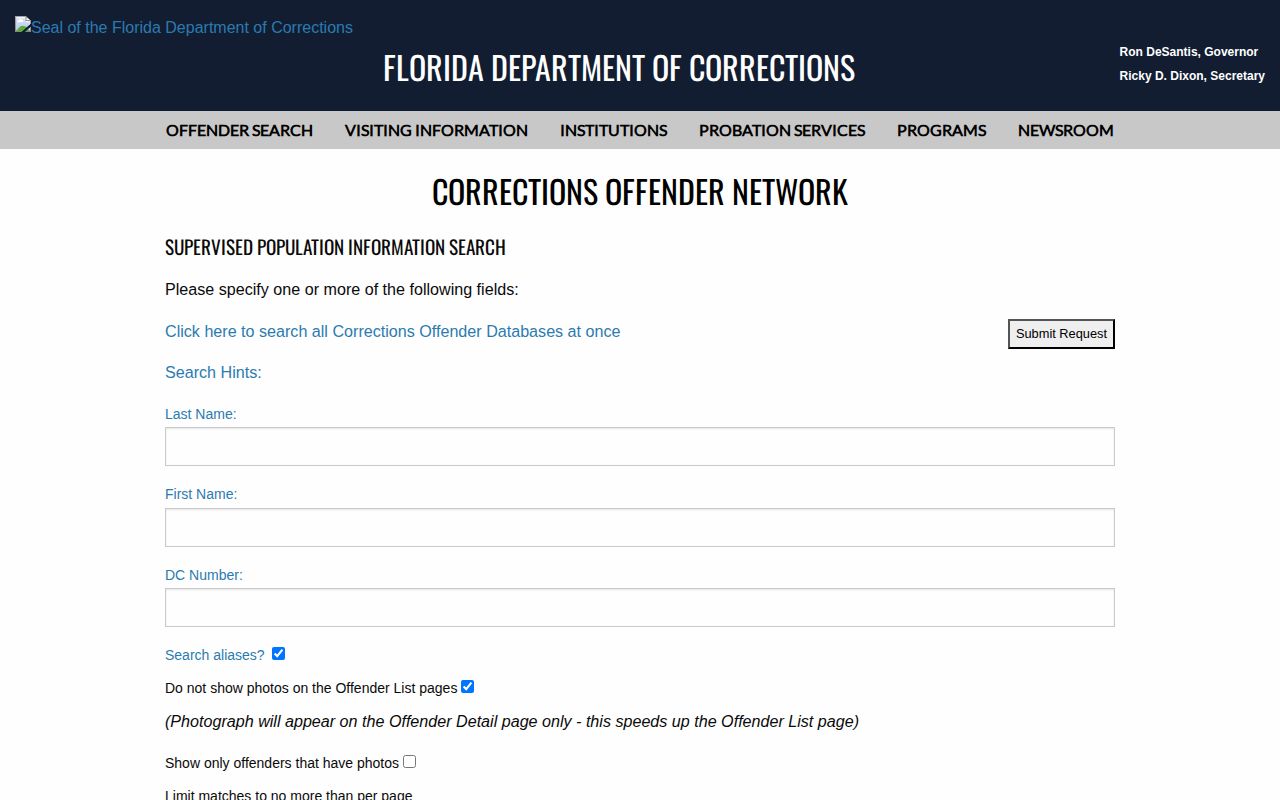
Its distinct status fields show why prison release and the end of supervision must be verified separately.
Miami-Dade Probation Office Route
Miami-Dade is Florida's 11th judicial circuit. The FDC Miami Circuit directory lists the main office plus reporting sites in Miami Northwest, Miami South, Miami North, Homestead/Florida City, Biscayne, Hialeah, and Miami Lakes. Use the office link in the person's record. The circuit headquarters is not proof of the assigned reporting location.
FDC Miami Circuit401 NW 2nd Avenue, Room S612, South Tower
Miami, FL 33128
305-377-7040
miami.cir@fdc.myflorida.com
FCOR Miami Field Services serves Dade and Monroe from PO Box 10351, Miami, FL 33101, at 305-349-1293. It supports commission investigations and review. It is not a probation reporting office.
Miami-Dade Absconder Status
FDC status words have narrow meanings. Active Suspense means a person is temporarily unavailable for direct supervision, often due to jail or another facility, while staff monitor the case. It does not mean unrestricted release. The Absconder/Fugitive search covers a person whose whereabouts are unknown or unavailable for supervision and for whom a violation warrant has issued.
- Condition
- A rule imposed by the court, FCOR, or supervision authority.
- Violation
- An alleged failure to follow a supervision rule.
- Absconder
- A supervised person reported unavailable with a violation warrant.
- Discharge
- The formal end of supervision.
A public result is not authority to approach or detain anyone. Refer warrant questions to the listed agency or court. Note: A scheduled termination date is a planned endpoint, not proof that discharge has been entered.
When Miami-Dade Supervision Ends
Supervision ends through a formal termination or discharge, not simply when a date passes on an old screen. For probation, compare FDC status with the Miami-Dade Clerk's order. For parole, obtain the commission action and check the FDC record. A violation, new custody, court change, or commission action can alter the planned endpoint.
FCOR accepts requests for an individual action through its public-records channel. Include the name, DC number, hearing date, and case number. The commission record explains parole action, while FDC shows actual custody and supervision.
Miami-Dade Parole Hearing Records
The FCOR schedule rolls by month. Normal in-person hearings occur Wednesdays at 9 a.m.; Thursday follow-ups use video or teleconference. A date opens an agenda with name, DC number, action category, county, offense, case number, panel grouping, and meeting mode.
An agenda is not a decision and does not prove release. No official name-searchable post-meeting decision database was found. Request the written action from the Commission Clerk at 850-488-1293 or publicaffairs@fcor.state.fl.us, then verify departure through FDC Inmate Release Information and continued oversight through Supervised Population. A presumptive parole date remains tentative, while an effective date also depends on conduct and an acceptable release plan.
Miami-Dade Reentry After Supervision
MDCR Reentry Program Services provides counseling, action plans, case management, and referrals through release. FDC also maintains a resource directory filterable by county, circuit, city, and ZIP. These tools help locate services, but neither proves custody status or discharge.
One person may leave a Miami-Dade jail and begin probation without entering state prison. Another may leave FDC and begin parole or conditional release. The correct record path follows the court or commission order and the agency involved.
Miami-Dade Release Property and ID
MDCR holds booking property at TGK for up to 30 days. After that, pickup requires the offsite property route at 786-263-5355. This is a property deadline, not a supervision or record-retention period.
For eligible Florida-born state prisoners, §944.605 provides for a birth certificate and state ID before sentence-expiration release, subject to exceptions. That state rule does not govern property held after a Miami-Dade jail release.
Read Miami-Dade Supervision Status
An FDC detail should be read as a group. The begin date shows when supervision started. Supervision type distinguishes probation, parole, conditional release, community control, or another program. Current status states whether the record is active, suspended, or otherwise classified. The scheduled termination date is an expected endpoint, not a certificate that the duty ended. The location identifies the circuit office attached to the record.
The offense and case history help connect a person to the Miami-Dade judgment. A photograph and DC number are stronger match points than a shared name. If the record conflicts with a court order, obtain the official document and ask the assigned office about the current entry. For parole, request the FCOR action too. Each record has a separate role.
Probation can start after a county jail release with no state-prison custody. Conditional release and parole usually follow a state-prison path. A physical release date cannot reveal which form applies. The supervision type, court judgment, and commission action answer that question.
Miami-Dade Parole Eligibility Records
Florida parole eligibility is limited and case specific. Ordinary parole was effectively ended for crimes committed on or after October 1, 1983, but FCOR identifies older and special statutory groups. Official summaries also conflict about one continuing-criminal-enterprise cutoff. A simple date rule is unsafe. Use the offense date, judgment, sentence, section 947.16, and FCOR review.
The statute sets initial interview timing based on sentence length. It does not guarantee release. A presumptive parole date remains tentative. An effective date also depends on satisfactory conduct and an acceptable release plan. Commission action can authorize parole, postpone action, or alter a presumptive date.
Start with the schedule and agenda, then obtain the written action. Finish by checking FDC Inmate Release Information for physical departure and Supervised Population for active oversight. This chain keeps a hearing date from being mistaken for a decision or a decision for a completed gate release.
Miami-Dade Probation Court Record
Probation begins with a court order, so the Miami-Dade Clerk record remains essential. Review the judgment, sentence, probation or community-control order, and later violation or termination entries. FDC is the practical live status tool, but the court document supplies the legal terms and case number. A dismissal or time-served entry may explain why jail ended without creating parole.
A new arrest does not by itself state that supervision was revoked. An alleged violation is not the same as a final ruling. Use the docket to locate the order and request a certified copy when the outcome matters. FDC can then clarify how it reflects that order in the current supervision status.
Termination also needs an official entry. A scheduled end date can change after a violation, new court order, custody event, or commission action. Compare current FDC status with the final court or FCOR record. When they differ, contact the assigned Miami Circuit office with the DC and case numbers. This avoids treating an old planned date as proof that all conditions ended.
A formal discharge record is the reliable endpoint. Keep it with the related judgment or commission action so physical release and the end of supervision remain distinct.