
RRM Miami Placement Outcomes
Residential Reentry Management Miami is operated by BOP as a community-corrections management office. It oversees contracted residential reentry centers and home-confinement placements. The office at 401 N Miami Avenue is an administrative address. It should never be presented as a detention bed or as proof that a named person is physically there.
A person linked to RRM Miami may remain in BOP custody in a contracted placement or home confinement. Later, a past BOP release date may show that BOP custody ended, while court-ordered supervised release continues. These stages are distinct and must be traced through the register number and actual placement record.
| Event | Meaning |
|---|---|
| RRM or contracted placement | Community placement may remain within BOP custody |
| Past Release Date and Released location | BOP custody ended on the recorded date |
| Federal court release order | The judge authorized release and set any conditions |
| No public match | Identifiers or agency records need further checking |
Confirm RRM Miami Release
Begin with the BOP locator for federal records from 1982 forward. Search by register number when known. A name search can be narrowed with age, race, and sex, but the matching result must be checked as a whole before it is treated as the right person.
Follow this state-record sequence:
- Open the BOP Inmate Locator.
- Search by register number or use the name and optional identifiers.
- Read Release Date together with the Location field.
- Check the Southern District of Florida docket for the controlling order.
- Follow a transfer to another BOP facility or another custodian.
- Contact BOP or the named facility if the public fields remain unclear.
The federal court docket supplies the order behind detention, release, or sentencing. It does not replace the BOP custody result. Likewise, MDCR’s 72-hour county listing cannot confirm a federal departure. The Miami-Dade release record overview compares county, state, federal, and immigration paths.
RRM Miami Locator Fields
BOP results show name, register number, age, race, sex, release date, and location. A past date plus Released or no institution indicates the person is no longer in BOP custody. That precise phrase should be preserved because another agency’s custody or court supervision can follow.
A future date is projected and may change as a federal sentence or credits are recalculated. UNKNOWN means the confinement term is not determined. For a pretrial defendant, the docket may supply clearer context because the judge’s order controls release conditions.
- Register number
- The federal identifier used for the strongest BOP match.
- Release Date
- The recorded or projected end date for BOP custody.
- Location
- The current BOP institution or the Released status.
- Supervised release
- Court-ordered oversight after imprisonment, tracked outside the locator.
Note: Read the register number, date, and location together; no single BOP field explains every custody transition.
RRM Miami Supervision Boundary
Federal supervised release is ordered by the sentencing court and follows imprisonment in many cases. It is not BOP physical custody. Review the judgment and later docket entries, then contact the appropriate U.S. Probation office when the current supervision status must be confirmed.
Pretrial release is different. A judge may set bond and conditions while the criminal case remains open. The docket shows that legal event. A BOP release date cannot tell whether the person left under pretrial conditions, completed a custodial term, or moved to another sovereign.
RRM placement and federal supervised release are not synonyms. BOP manages the reentry placement while BOP custody continues. U.S. Probation administers court-ordered supervision after the custody phase. The judgment and docket define that later status, while BOP records define placement and release.
RRM Miami Placement Records
A records request should identify the federal register number, dates, RRM office, and exact placement transaction sought. Useful terms include designation history, contracted residential reentry placement, home-confinement period, and BOP release date. Ask for the actual placement record rather than assuming the administrative office was the residence.
Federal Record Sources
BOP Inmate Locator
Southern District of Florida docket
Federal Bureau of Prisons records
National Archives for pre-1982 custody records
Use the BOP locator record guide for field meanings and the older-record route. Pre-1982 federal custody questions go to the National Archives with the name, birth or approximate age, race, and approximate custody dates.
Florida public-record fees do not govern BOP files. MDCR cannot produce a federal release transaction, and the Miami-Dade Clerk does not hold the federal docket. Sending the request to the agency that created the record avoids a false county trail.
RRM Miami Contact Details
Residential Reentry Management Miami is at 401 N Miami Avenue in Miami. BOP lists it as a community-corrections management office. Contact can help identify the office responsible for a placement, but it does not prove a person is housed at that address.
Residential Reentry Management Miami
401 N Miami Avenue
Miami, Florida
Operator: Federal Bureau of Prisons
Role: community-corrections management office
The official BOP RRM Miami page identifies the administrative reentry office.
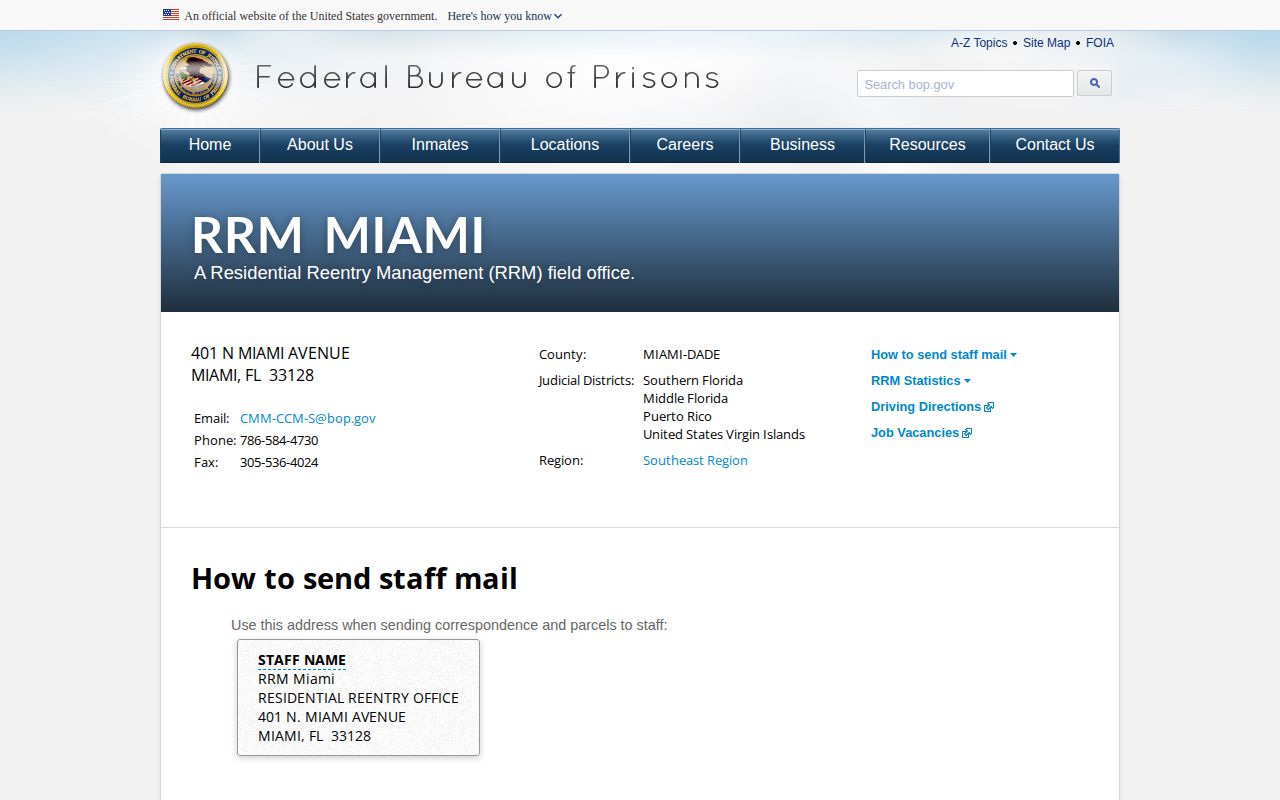
The source shows the office role; the register-number and contracted-placement records establish the individual status.
RRM Miami Release Date
BOP states that a past release date paired with Released or no institution means BOP custody ended. A future date is projected and can change as the federal sentence and credits are recalculated. UNKNOWN means the confinement term has not been determined. None of these terms promises a fixed exit hour.
For a person in reentry placement, the BOP date still controls the public locator result. Transfer to an RRM-managed center or home confinement can occur before that date and does not by itself prove BOP custody ended.
Florida’s state-prison gain-time law and Miami-Dade’s county good-time law do not control a federal detention record. Geography does not change the governing system. Use federal records for the custody date and the federal docket for the judicial basis.
A detainer can affect the destination after BOP custody. Read the court filing or BOP record for the receiving agency, then search that agency. The release date alone answers only when BOP custody ended.
RRM Miami Detainer Transfer
Conflicting federal dates should be compared by source and function. The docket establishes the court action. BOP records show the federal custody status. A receiving-agency entry shows what happened after BOP. Those records may be accurate while describing different stages.
If an immigration detainer appears, search the ICE Online Detainee Locator System. ICE says the locator includes people released from ICE custody during the prior 60 days. Release, transfer, and removal remain distinct outcomes that require ICE or immigration-court context.
For state or county custody, use the receiving system named in the record. MDCR applies only if Miami-Dade Corrections actually received the person. Never infer final release merely because an RRM placement ended.
Note: The strongest RRM Miami finding pairs the BOP result with the actual placement and supervision records.
RRM Miami Home Confinement
Home confinement and residential reentry are managed settings, not proof that the federal sentence has fully ended. RRM Miami can oversee both types of placement. Track the register number and BOP date while also confirming the actual contracted center when that information is public.
The U.S. Marshals Service controls federal prisoners from court-ordered custody through release, acquittal, or delivery to BOP after conviction. USMS can use contract state, local, or private facilities and does not offer a public historical locator like BOP. A federal defendant may therefore have a custody path that is not fully shown by one BOP result. The court case number and register number help join those stages.
When the docket shows release but the BOP location has not changed, allow for processing and verify with the appropriate federal office. When BOP shows Released but the docket contains no clear public order, inspect later entries and request the relevant court document. A court order is legal authority; a locator status is an agency custody report. Each answers a different question.
A completed BOP release can lead to reporting with U.S. Probation. That is court supervision, not an RRM placement. The judgment defines the term, while later docket entries may show changes. Florida’s state Supervised Population search does not cover federal supervision.
This source split prevents three errors: treating the office address as a residence, treating a reentry placement as final release, and treating the end of BOP custody as the end of supervision. The BOP locator, placement record, and federal docket form the full chain.