
Krome Release Outcomes
Krome North Service Processing Center is operated by U.S. Immigration and Customs Enforcement, Enforcement and Removal Operations. ICE material also uses Krome Service or Special Processing Center. It is not an MDCR jail, a Florida prison, or a BOP institution. The A-number is the strongest search identifier.
A person may leave Krome through conditional community release, transfer to another ICE site or custodian, or removal from the United States. ODLS documents custody status, but the result may not explain which outcome occurred. ICE paperwork, ERO information, and immigration-court status supply that context.
| Event | Meaning |
|---|---|
| New ICE location | Immigration detention continues elsewhere |
| Released ICE result | ICE custody changed within the published 60-day window |
| Release paperwork | The document identifies terms or the type of ICE action |
| No public match | Identifiers or agency records need further checking |
Confirm a Krome Release
Begin with ICE’s Online Detainee Locator System. The preferred search uses the nine-digit A-number and country of birth. Add leading zeros when the A-number has fewer than nine digits. The alternate route requires exact first and last names plus country of birth, with date of birth optional.
Follow this state-record sequence:
- Open the ICE Online Detainee Locator System.
- Search with A-number and country of birth when possible.
- Use exact name and country of birth if the A-number is unknown.
- Compare the result with ICE paperwork and the known detention path.
- Check ERO and immigration-court status to interpret the departure.
- Call ICE DRIL when an adult record cannot be resolved online.
An immigration-court record supplies case context but does not replace ICE custody data. Likewise, MDCR’s 72-hour county listing cannot confirm departure from Krome. The Miami-Dade release record overview compares county, state, federal, and immigration paths.
Krome ODLS Search Fields
ODLS offers two search routes. The A-number route uses a nine-digit number and country of birth. The biographical route uses exact first and last names, country of birth, and an optional birth date. ICE says the system does not cover people under 18.
ICE states that ODLS covers current ICE custody, people held by CBP more than 48 hours, and people released from ICE custody during the prior 60 days. That archive window is longer than Miami-Dade’s county release view but far shorter than many court records.
- A-number
- The immigration identifier used for the strongest ODLS search.
- Country of birth
- A required field in both documented search routes.
- Conditional release
- Release from detention under immigration conditions.
- Removal
- Departure from the United States under immigration authority.
Note: ODLS is a custody locator, not a full explanation of the immigration case or release terms.
Krome Immigration Case Status
Immigration detention and immigration-court proceedings are linked but not identical. ODLS reports custody information. The court case can show hearing and case status. Release paperwork may set reporting or monitoring terms. One source cannot be made to answer every part.
A person released conditionally can remain in active immigration proceedings. A transfer can move the person to another site without ending detention. Removal ends presence in ICE detention through a different path than community release. Use the wording in official paperwork rather than flattening all three events into one label.
When online data conflict, contact ERO or ICE’s Detention Reporting and Information Line. DRIL is 1-888-351-4024 and is staffed Monday through Friday, 8 a.m. to 8 p.m. Eastern, with language help for basic case information and detention concerns.
Krome Release Records
A focused inquiry should identify the A-number, full name, country of birth, Krome, and the date range. Ask for the custody action, release or transfer paperwork, and destination or conditions when those details are available. Exact fields are more useful than a request asking an office to explain the whole case.
Immigration Record Sources
ICE Online Detainee Locator System
ICE Enforcement and Removal Operations
Immigration-court case status
Release or transfer paperwork
The ICE family and attorney resource documents the 60-day released-record window. Keep a copy of the person’s paperwork because the ODLS history is time limited and the document may explain the authority and conditions.
MDCR cannot produce Krome’s ICE custody transaction. A county record can show that MDCR released a person to ICE, but the next event belongs to ICE. Sending each request to its originating agency preserves that chain.
Krome Records and Contact
Krome North Service Processing Center is at 18201 SW 12th Street, Miami, Florida 33194. ICE lists the facility telephone as 305-207-2001. Facility contact and ERO can help interpret a Krome event, while ODLS remains the public person-search route.
Krome North Service Processing Center
18201 SW 12th Street
Miami, FL 33194
305-207-2001
Operator: ICE Enforcement and Removal Operations
The official ICE Krome page identifies the detention facility.
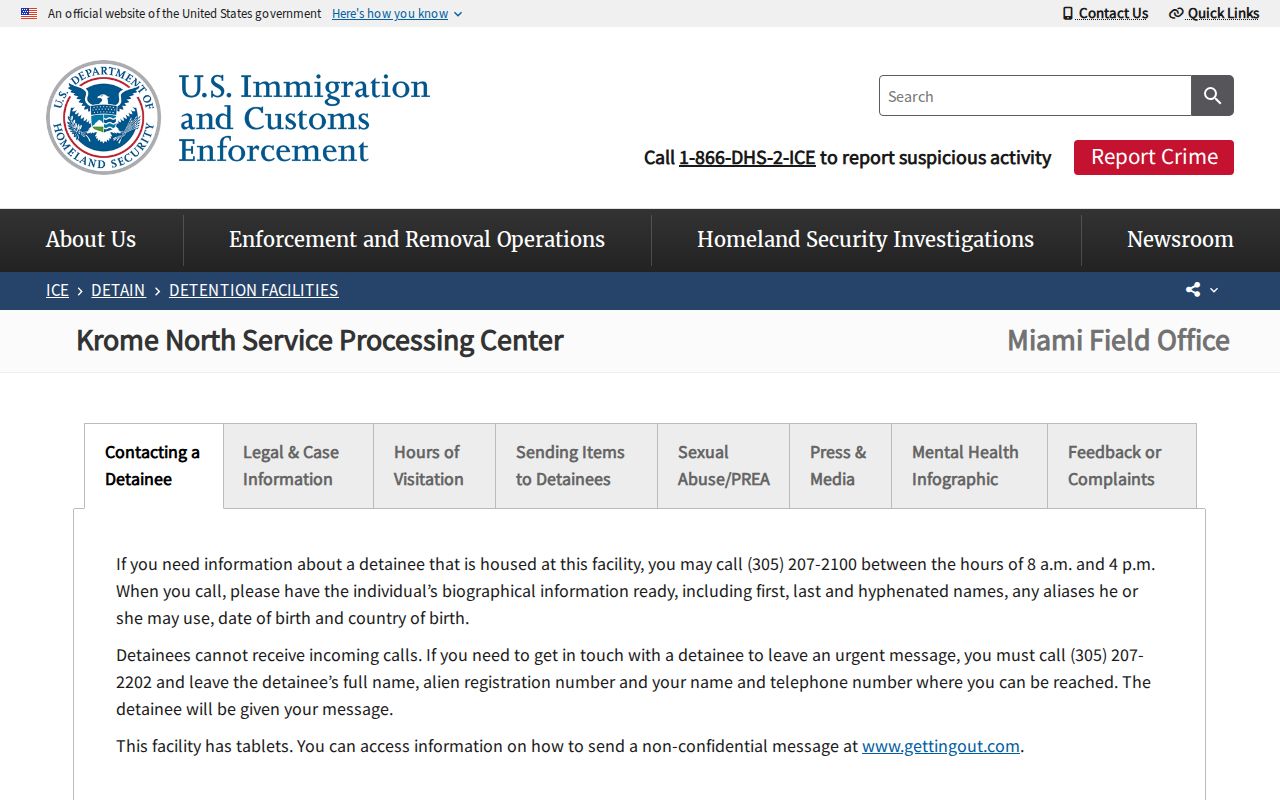
The image confirms the correct facility; ODLS and case records supply the person-level status.
Krome Sixty-Day Window
ICE’s documented 60-day ODLS window is the central historical limit. A person released from ICE custody can remain searchable during that period. After it passes, a missing online result has little value by itself. Use paperwork, ERO, DRIL, and immigration-court information instead.
The window does not turn ODLS into a permanent release archive. It also does not define the retention of underlying ICE records. Web visibility and agency record retention are separate matters.
Miami-Dade’s county release listing lasts 72 hours, but it answers an earlier custody stage when MDCR transfers someone to ICE. The county transaction can name ICE as the destination. Krome and ODLS then become the next search layer.
A BOP result is relevant only if the person also passed through federal criminal custody. Krome itself is an ICE site. Agency type, not the Miami address, decides which locator applies.
Krome Detainer Transfer Chain
Conflicting Krome records should be compared by source and function. ODLS reports ICE custody status. Release or transfer paperwork identifies the agency action. The immigration-court record supplies case status, while a receiving-agency entry shows what happened after ICE. These sources can all be accurate while describing different stages.
If an MDCR immigration detainer appears, search ODLS next. ICE says the locator includes people released from ICE custody during the prior 60 days. Release, transfer, and removal remain distinct outcomes that require ICE or immigration-court context.
For state, county, or federal custody, use the receiving system named in the record. Never infer community release merely because Krome no longer appears as the ICE location.
Note: The strongest Krome finding pairs ODLS with ICE paperwork and immigration-court or receiving-agency records.
Krome Release Interpretation
Conditional release means the person leaves physical immigration detention under stated terms. It does not mean the immigration case ended. Reporting, monitoring, hearings, and other obligations may continue. The release paperwork is the best source for those terms.
Transfer means custody continues with a different ICE site or another agency. Removal is a distinct immigration action and should not be called community release. ODLS status may show the custody change, while ERO and immigration-court information help identify the legal path.
When ODLS does not resolve the question, verify spelling, A-number padding, and country of birth. Then contact DRIL or ERO. Do not substitute a BOP register-number search or Florida prison search simply because Krome is a federal facility in a broad sense.
This source split prevents three common errors: treating a county transfer to ICE as freedom, treating departure from Krome as proof of conditional release, and treating a 60-day online window as permanent retention. The county transaction, ODLS, paperwork, and immigration case form the full chain.
Krome Release After MDCR
Miami-Dade’s daily jail report includes immigration holds and detainers. That local fact changes how a county roster disappearance should be read. MDCR may record a release transaction because its own custody ended, while ICE immediately begins a new custody episode. In that situation, the county event is real but the person did not enter the community.
Start with the MDCR release transaction when the custody path began in a Miami-Dade jail. Ask whether ICE was the destination. Then use the A-number and country of birth in ODLS. If the person later leaves Krome, obtain the ICE paperwork or ERO information that distinguishes conditional release, movement to another site, and removal.
The 72-hour county view and the 60-day ICE view overlap only for a short time. Save the jail number, A-number, dates, and case identifiers while both are available. After the web windows close, those identifiers make agency and court requests far more precise.
A Miami-Dade criminal case and an immigration case also have different dockets. The county court record may explain the local charge or release authority. It cannot establish the final ICE action. Immigration-court status may supply later case context, but ICE remains the source for the detention transaction.
Note: An MDCR-to-Krome path requires two custody records because county release and ICE release are separate events.