
Miami-Dade Projected vs Actual Release
FDC labels the future public field Current Release Date. Florida law calls the underlying calculated date a tentative release date. It is a forecast based on the controlling sentence and available credits. It can move. After release, FDC Inmate Release Information uses the historical Release Date and Date Out-Custody to show when state custody ended.
A Miami-Dade pretrial detainee has no computed sentence endpoint. Bond, dismissal, a court order, a new hold, or transfer can control the event. A county-sentenced person may have a calculation, but MDCR applies county rules rather than the FDC prison formula.
Find Miami-Dade Projected Release Dates
Start by deciding whether the person is in MDCR county custody or an FDC state prison. County-only detainees do not gain an FDC record just because the case began in Miami-Dade. For a state prisoner, use the FDC Corrections Offender Network. For a county jail sentence, obtain the judgment, jail-credit entry, and MDCR calculation. The Miami-Dade released inmate search path explains how to confirm a completed county event.
- Select FDC Inmate Population for an active state prisoner.
- Search by DC number or name and verify the identifiers.
- Read Current Facility, Current Custody, and Current Release Date together.
- If the field says TO BE SET, wait for review or contact Admission and Release.
- After the event, use Inmate Release Information and Date Out-Custody.
The official FDC example shows the Current Release Date field and its change warning.
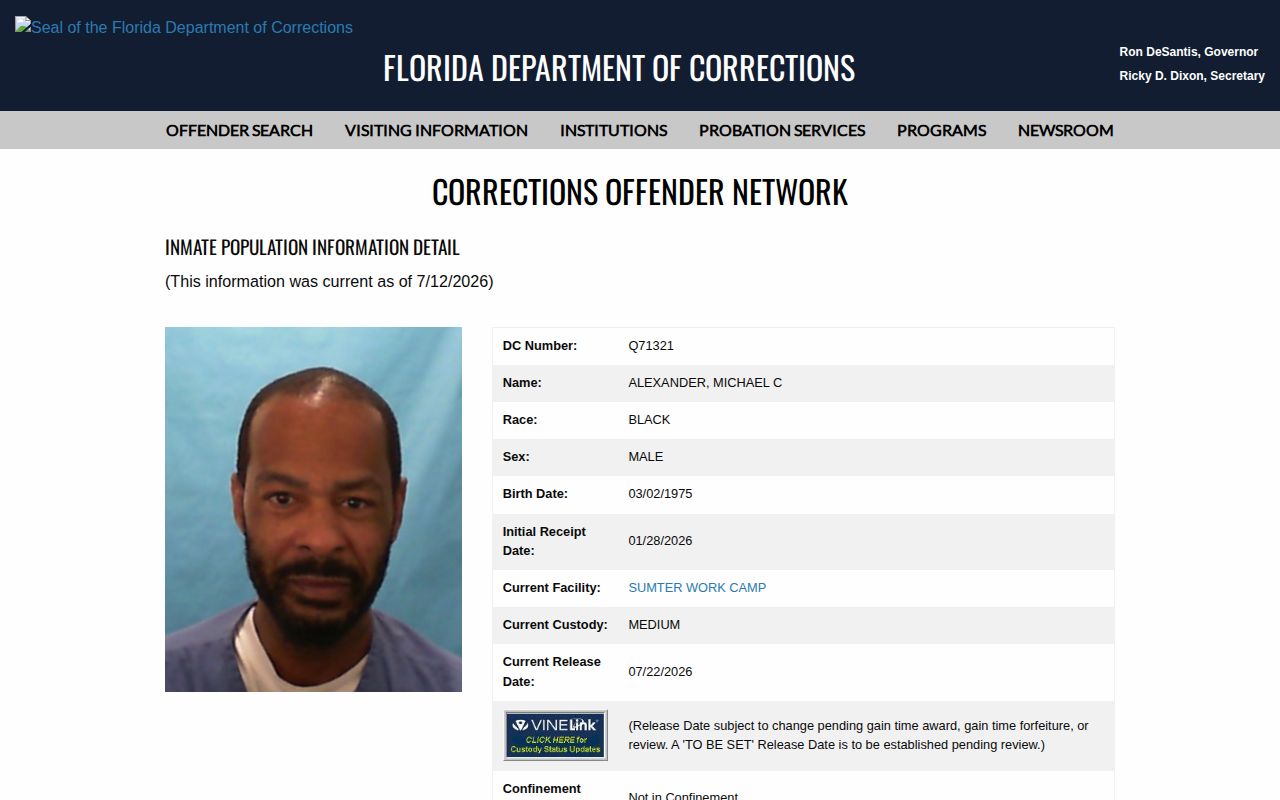
The warning beneath the date is part of the record and should be read with custody and location.
Florida Prison Release-Date Calculation
Florida Statutes §944.275 begins with maximum sentence expiration: the imposed sentence or combined sentences less lawful credit. FDC's tentative date projects gain-time and changes as credit is granted, restored, or forfeited. It cannot be later than maximum expiration.
For offenses committed on or after October 1, 1995, FDC may grant up to ten days per month of incentive gain-time, subject to offense exclusions and date rules. Section 944.275(4)(f) prevents gain-time from causing release before service of 85 percent of the sentence. Court-awarded physical custody credit counts toward that floor. Under §921.161, the court must specify presentence jail credit. Sentence length alone is therefore not enough for a sound estimate.
Older basic gain-time provisions apply only to specific cohorts. They are not a universal monthly deduction for modern cases.
Why Miami-Dade Release Dates Change
A release projection can move earlier or later when the legal inputs change. The public date should be treated as a current calculation, not a promise. A hold can also mean the person leaves one custodian but does not return to the community.
| Factor | Effect | Record to verify |
|---|---|---|
| Gain-time award or loss | Moves the tentative date | FDC calculation |
| Corrected jail credit | Changes credited custody time | Judgment and FDC audit |
| Amended or consecutive sentence | Changes controlling term | Court order |
| Detainer or hold | May send the person to another agency | Custody and receiving record |
| Parole or conditional mechanism | May add a different release path | FCOR or FDC action |
| Administrative review | May produce TO BE SET or a revision | FDC Admission and Release |
Confirm Miami-Dade Inmate Release Dates
FDC says release dates and locations update nightly, while the full Inmate Population database refreshes weekly. Brief differences among the court, MDCR, and FDC can occur during intake or recalculation. The Bureau of Admission and Release handles state release-record questions at 850-488-9167 and dc.release@fdc.myflorida.com.
For a county sentence, contact MDCR Inmate Records at 786-263-4222 or Release at 786-263-5360. Ask for the effective release date and time, release authority, and any transfer destination. A VINE alert can provide quick notice, but the agency record remains the stronger proof. The VINELink Release Check explains that separate notification channel.
Miami-Dade Jail Good-Time Rules
Florida's county-jail authority is separate from the state-prison formula. Under §951.21, the county commission may govern good-conduct commutation unless it discontinues or revises the statutory policy. The statute sets possible monthly levels by year served and allows added good time on recommendation, while also allowing forfeiture.
Those statutory maximums do not prove how MDCR calculated one person's date. Request the applied policy, sentence computation, judgment, and jail-credit record. No statewide Florida law was found that automatically moves every weekend county release to Friday.
Miami-Dade Release-Time Reality
Completed county releases occur through Turner Guilford Knight Correctional Center between 6 a.m. and 9 p.m. MDCR warns that processing can take hours after bond or court requirements are met. This operational window does not create an exact appointment and does not alter the legal sentence calculation.
A person moved from MDCR to FDC, ICE, federal custody, or another county has left the local jail but has not necessarily entered the community. Follow the receiving system before calling the event a completed discharge. Note: The projected date and the place of physical exit answer different questions.
Miami-Dade Jail Credit Records
Presentence jail credit can affect a state-prison calculation. Under section 921.161, the sentencing court specifies credit for physical time served before sentence. Qualifying custody after sentence but before FDC delivery is supported by the local custodian's certificate. FDC applies those inputs to the controlling sentence. An estimate from sentence length alone can be wrong when the judgment, credit, or sentence structure is missing.
Locate the Miami-Dade judgment and sentence first. Note whether terms run at the same time or one after another. Compare court credit with the FDC detail. If a correction or amended order appears, Current Release Date may change after processing. Ask Admission and Release for the calculation or audit when a mismatch remains.
County jail time uses a different computation when the sentence stays with MDCR. Request the county policy and calculation. The statewide 85 percent framework governs modern FDC prison sentences, not every Miami-Dade county-jail sentence.
Miami-Dade Release Date Updates
FDC states that locations and release dates update nightly, while the full Inmate Population database refreshes weekly. Inmate Release Information also updates nightly and includes people already released or scheduled for release. These schedules can produce a short gap between a Miami-Dade court order, MDCR transfer, FDC intake, and the public state record.
Read the date with Current Facility and Current Custody. A facility change may be an internal transfer. TO BE SET means the public date awaits review, not that no sentence exists. The warning beneath Current Release Date says the value can change through gain-time awards, forfeiture, or review. Capture the DC number and contact FDC instead of calculating a replacement.
After release, switch categories. Release Date and Date Out-Custody confirm the state exit. Then use Supervised Population to learn whether probation, parole, conditional release, or another status continues. Prison release and supervision discharge are separate milestones.
Holds Change Miami-Dade Release Paths
A detainer is a request by another authority to hold or receive a person. It may not change the mathematical sentence end, but it can change where the person goes. Immigration, federal, another county, or another state authority may become the next custodian. One system can show a release even though the person did not return to the community.
For MDCR, ask whether another agency assumed custody and request any nonexempt destination. For FDC, read out-custody history and obtain the transaction if the public result is unclear. Follow ICE through ODLS and BOP through the federal locator. The receiving record gives context that a projected date cannot provide.
Miami-Dade Sentence Date Terms
Maximum sentence expiration and tentative release are not synonyms. Maximum expiration begins with the imposed sentence or combined terms less lawful credit. The tentative date reflects gain-time FDC has granted, restored, forfeited, or projects under law. It may move earlier or later but cannot be set after maximum expiration. Current Release Date displays that working calculation.
Concurrent sentences run at the same time, while consecutive terms run one after another. An amended judgment can change the structure. Court-awarded jail credit also changes the inputs. A person should not subtract a standard percentage from the announced term and call the result official.
For offenses on or after October 1, 1995, incentive gain-time remains subject to exclusions and the 85 percent limit. Older provisions apply to specified groups. The offense date and controlling judgment must be known before choosing a rule.
Verify Completed Miami-Dade Release
A projected date stops being the key evidence once the event occurs. For state prison, search FDC Inmate Release Information and match DC number, identifiers, Release Date, and Date Out-Custody. Then search Supervised Population. A person can be out of prison while still subject to probation, parole, conditional release, or community control.
For a county sentence, the MDCR transaction supplies effective date and time. The Clerk judgment explains the authority and credit. VINE can provide quick notice, but its message is not a certified calculation. When a transfer is named, check the receiving agency before describing the person as back in the community.
Keep the identifier used by each system. MDCR uses a jail or booking number, FDC uses the DC number, BOP uses a federal register number, and ICE commonly uses an A-number. Names alone can match the wrong person. The identifier also helps a custodian locate the calculation, release transaction, or custody history without guessing which episode applies. Record the search date as well, because projected values and custody locations can change after the screen is viewed.
When sources conflict, contact the agency that owns the current custody record before relying on the displayed date. Give the correct jail, DC, federal register, or A-number and ask which record controls the current calculation or custody status.