
Official Miami-Dade 72-Hour Releases
Miami-Dade Corrections and Rehabilitation Department publishes one inmate search with a recent-release option. The MDCR search FAQ says it gives a list of people released within the last 72 hours. The option sits inside the same application used for current custody; there is no separate feed URL. This documented rolling period is the county's official recent-release product.
The wider view helps when the exact day is uncertain. A search made Monday can still catch entries from part of the weekend, depending on the rolling cutoff. A post-holiday check can span more than one processing day. Yet 72 hours is a display window, not a statement about how long MDCR keeps the underlying agency record. When an entry rolls off the page, request the archived booking and release transaction rather than assuming the record was destroyed.
Check Miami-Dade Three-Day Releases
The official form requires at least three characters of both the first and last name. Search the recent-release option, not just the current-custody side. Then match the booking episode carefully. Similar names, aliases, and repeat bookings can create a wrong match if the jail number or other identifiers are ignored.
- Open the official MDCR inmate search and select the releases-within-72-hours option.
- Enter the required name characters and review each possible match.
- Compare the jail or booking number, identifying data, location, and any date information the live card provides.
- Record the displayed release details and call MDCR Release at 786-263-5360 if the time, type, or destination is missing.
- Check the court case or receiving custody system when the result points to bond, a court order, state prison, federal custody, or ICE.
Do not treat a search miss as proof. Spelling, timing, a restricted record, a transfer, or the rolling cutoff may explain it. For a same-day manual subset of this official view, see Miami-Dade releases in the last 24 hours.
The MDCR application shown below is the county entry point for both active custody and the rolling recent-release option.
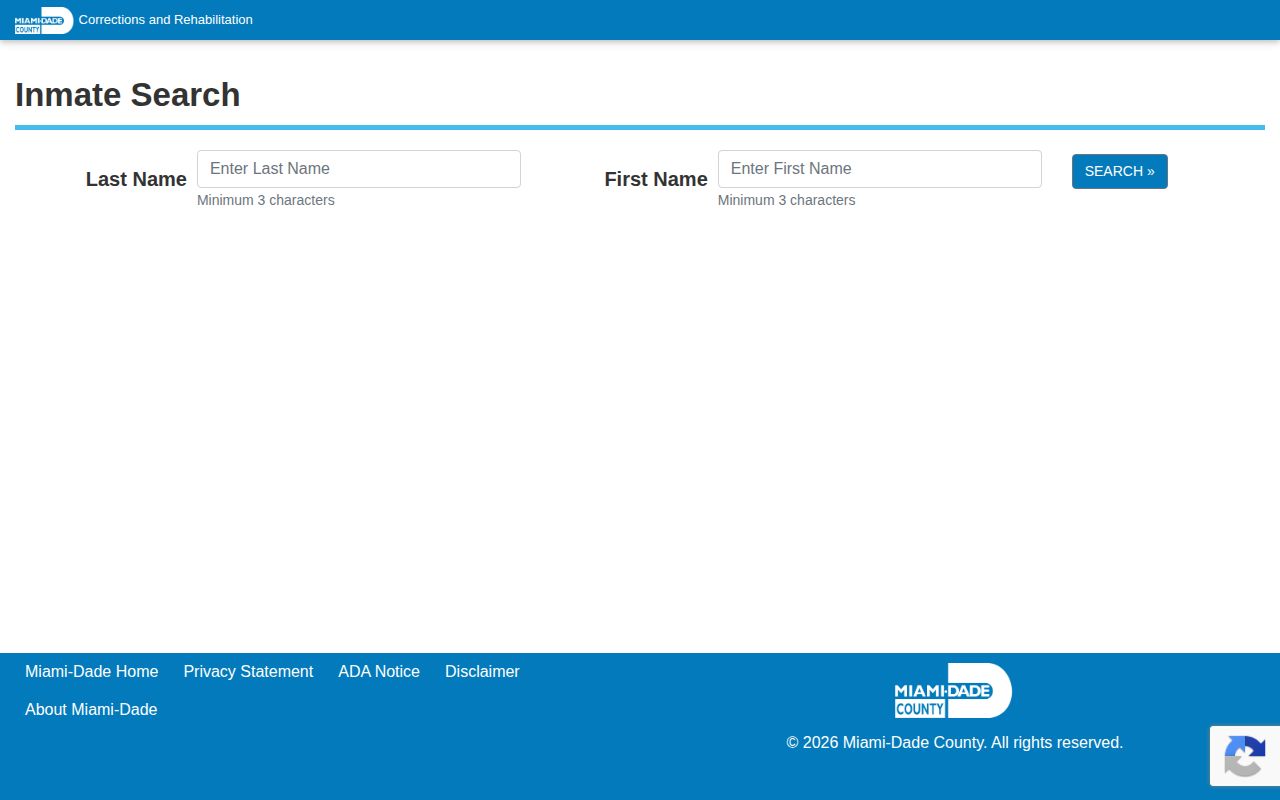
The search form begins the check. The public result and a direct MDCR response provide the release facts.
Miami-Dade 72-Hour Release Fields
The county's service description lists name, date of birth, race, sex, facility, charges, bond amount, jail number, booking time, and a mugshot for current-custody results. It does not guarantee that each field remains on a recent-release card. Read the live headings as presented and avoid filling gaps with current-roster assumptions.
| Field or fact | How to interpret it |
|---|---|
| Name and identity data | Help select the right person, but should be paired with a unique number when possible. |
| Jail or booking number | Connects the result to the exact MDCR custody episode and supports follow-up. |
| Booking date and time | Identifies when the custody episode began, not when it ended. |
| Release date and time, if displayed | Marks the reported end of MDCR custody and helps place the entry within the rolling window. |
| Facility or location | Shows county placement or monitoring context, which may differ from the TGK exit point. |
| Charges and bond | Give case context but do not prove the final release reason. |
| Release reason or destination, if displayed | Helps distinguish community return, monitored release, and transfer. |
When the public fields do not answer what happened, ask MDCR for the release transaction. A focused request names the person and booking number, then asks for effective release date and time, the authority or reason, and whether the destination was the community, monitoring, another jail, FDC, BOP, or ICE. A court order can then show the judicial act behind the change.
Miami-Dade Weekend Release Timing
The 72-hour span is most useful when office schedules or personal timing prevent a daily check. It can keep a Friday, Saturday, or Sunday event visible into a later search, subject to the rolling cutoff. The county does not state that the list refreshes at midnight or on a fixed minute schedule, so a searcher's calendar days may not line up with the application's exact 72-hour measurement.
Miami-Dade states that completed county releases occur through Turner Guilford Knight Correctional Center from 6 a.m. to 9 p.m. Processing can still take several hours after a court or bond event. No researched Florida rule automatically moves every weekend county release to Friday. The actual MDCR completion time must come from the release entry or agency transaction, not a presumed weekend schedule.
Holidays create the same need for care. A court action, transport decision, bond completion, physical exit, and web update can occur at different points. The rolling list catches more of that sequence than a same-day glance, but it does not resolve every time gap.
Note: The 72-hour Miami-Dade display window is separate from records retention and does not erase the archived release transaction.
After Miami-Dade Release Results Expire
Once the rolling result expires, call MDCR Release at 786-263-5360 or Inmate Records at 786-263-4222. Ask about the exact booking episode and whether custody ended through community release, monitored release, or transfer. For a written record, submit a Miami-Dade corrections public-records request for the booking and release transaction. State the desired fields so the response isolates the decisive event.
Florida VINE offers a quick status and notification layer for county jail and FDC records. It is not a certified release instrument, and a release alert may still require agency follow-up to rule out transfer. The Miami-Dade Clerk criminal docket can show a bond action, dismissal, probation order, sentence, or release order. For a named-person search that extends beyond this rolling window, use the Miami-Dade released-inmate records path.
Follow the receiving system when custody continued. FDC Inmate Release Information covers state prison, not a short county stay. BOP covers federal custody after 1982. ICE ODLS covers immigration detention and includes people released from ICE custody during the prior 60 days. Each system describes only its own custody.
- Release record
- The agency transaction that identifies when and how one custody episode ended.
- Rolling window
- A view that drops older entries as time passes, regardless of the agency's archive.
- Transfer
- A move to another custodian, not a return to the community.
- Monitored release
- Community-based custody or supervision subject to conditions, such as electronic monitoring.
Miami-Dade 72-Hour Roster Quirks
Miami-Dade documents one name-search tool with a last-72-hours option. It does not maintain a separate official 24-hour feed, and the 72-hour choice is embedded in the live inmate application. That design means current-custody results and recent releases must be read as different views of the same county system.
The NDCCC code is another local exception. North Dade Community Correctional Center is closed, yet MDCR explains that the code means a person is on house arrest with an ankle bracelet. It should be read as community-based monitoring, not as physical jail custody and not as unrestricted release. A person may therefore appear outside a jail while still subject to an MDCR-controlled status.
| Miami-Dade search clue | Safe reading |
|---|---|
| Live jail location | The person remains associated with current MDCR custody. |
| Recent-release entry | MDCR reports that the county custody episode ended; confirm what followed. |
| NDCCC location code | The person is on ankle-monitored house arrest, not housed at the closed site. |
| No result | Run fallbacks because the cause may be timing, transfer, cutoff, or restricted access. |
No official MDCR or sheriff mobile app with a distinct release feed was found. Use the county web service and Florida VINE rather than a community-reporting app. These Miami-Dade quirks are why roster absence alone never proves release.
Miami-Dade Release Evidence Levels
The official 72-hour card is useful for a quick, recent check, while a VINE notice confirms that a participating agency reported a status change. Neither source necessarily states the complete legal reason. MDCR's responsive release transaction is the county agency record of the custody event. It can identify the date, time, authority, and destination when those facts are requested with enough detail.
The Miami-Dade Clerk criminal case record serves a different role. Its case card and docket can supply bond, disposition, judgment, sentence, probation, or release-order context. The Clerk warns that the online display is not the official record, so a certified order or disposition is the stronger court source when authority matters. The precise custody completion time still comes from MDCR.
Keep each identifier found during the three-day search. A jail number connects the MDCR episode, a case number connects the court action, and a DC, federal register, or A-number connects a receiving system. That chain avoids relying on a name match after the rolling Miami-Dade release entry expires.